
Adaptive Footwear Explained for People With Mobility Challenges
- T. Armstrong

- Aug 7
- 9 min read
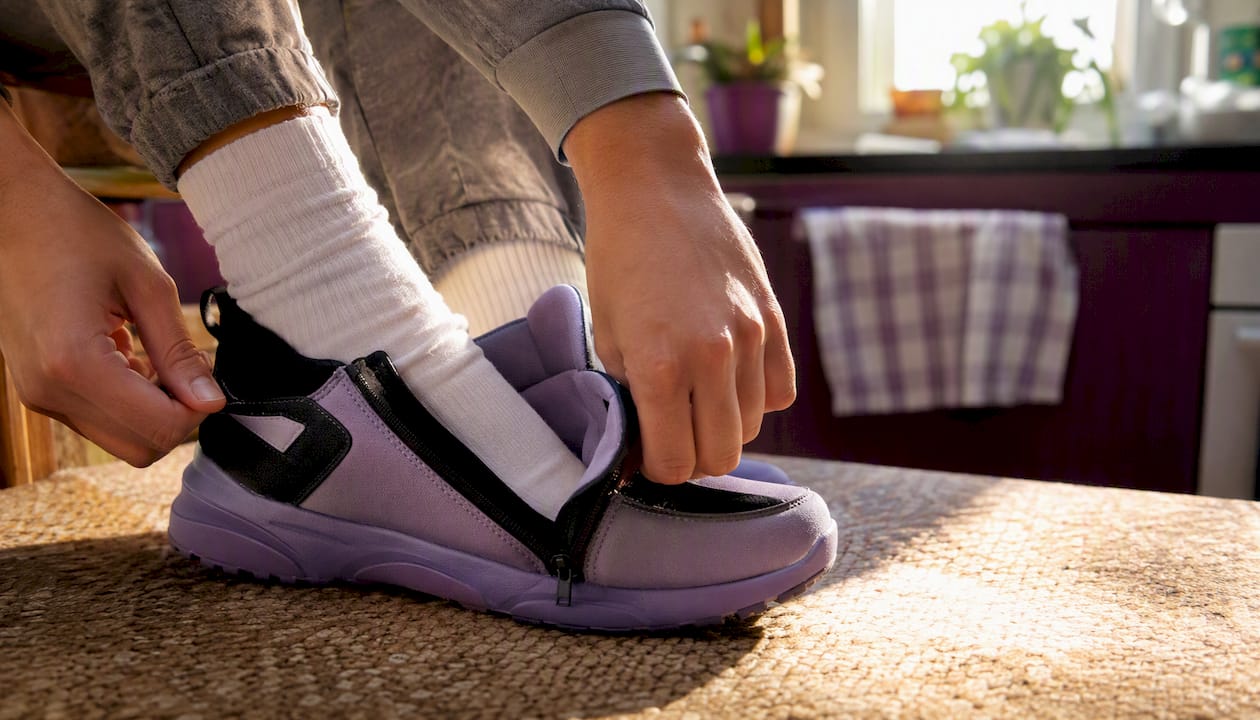
Adaptive footwear is specialized footwear engineered with features like extra depth, adjustable closures, and wider openings to help people with mobility challenges, chronic foot conditions, or temporary injuries dress independently and move more safely. Someone managing foot drop after a stroke, a senior navigating balance issues, or a person recovering from leg surgery all face the same core problem: standard shoes weren’t built for their reality. Adaptive shoes were. Three features show up in almost every well-designed pair:
Adjustable closures (Velcro straps, magnetic zippers, or elastic laces) that eliminate the need to tie laces with limited hand function
Extra depth to accommodate custom orthotics, AFOs (ankle-foot orthoses), or swollen feet
Removable insoles that allow orthotic inserts to sit properly without crowding the foot
The definition of adaptive footwear also includes anti-slip soles, seamless interiors to prevent pressure points, and pull tabs for easier handling.
Table of Contents
What does adaptive footwear actually do for you?
The core outcomes are improved stability, reduced pressure on sensitive areas, and easier independent dressing. Those aren’t small things when you’re recovering or managing a chronic condition. They’re the difference between needing help every morning and getting yourself out the door.
Stability matters most for fall prevention. The National Council on Aging links proper shoe features directly to fall-prevention strategies for older adults, noting that traction, fit, and heel support all play a role. Falls are one of the leading causes of injury-related hospitalization among adults over 65, and footwear is one of the few modifiable risk factors.
Statistic callout: Falls are the leading cause of injury-related death among older adults in the United States, and footwear choice is consistently identified as a modifiable risk factor in public health guidance from the National Council on Aging.
Pressure relief matters for anyone with neuropathy, diabetes, or post-surgical swelling. A shoe with a wide toe box and a seamless interior stops friction before it starts. For people who can’t feel their feet well, that protection isn’t optional. Peer-reviewed clinical evidence confirms that footwear design measurably affects gait, balance, and pressure distribution in clinical populations. Podiatrists and physical therapists routinely recommend adaptive features for patients managing these conditions.
Easier dressing is the benefit people underestimate until they need it. A side-zip or wrap-style shoe that opens fully flat means you don’t have to bend, balance on one foot, or fight with laces. For someone with limited grip strength, that’s not a convenience feature. It’s independence.
What features should you look for in adaptive shoes?
Every feature in a well-designed adaptive shoe exists for a functional reason, not a stylistic one. Here’s what each one does:
Extra depth: Creates room for custom orthotics or AFOs without cramping the foot. The Arthritis Foundation recommends extra-depth shoes specifically for people managing swelling and joint pain.
Pro Tip: When assessing closure quality in-store or online, flex the strap or zipper several times. A Velcro closure that loses grip after a few uses, or a zipper that snags on the lining, will fail quickly with daily wear. Look for reinforced stitching around closures and ask whether replacement straps are available.
What types of adaptive shoes are available in the U.S.?
Adaptive shoes solve different problems depending on how they’re designed to open, fit, and support. The main categories break down by ease of entry, orthotic space, and single-shoe availability.
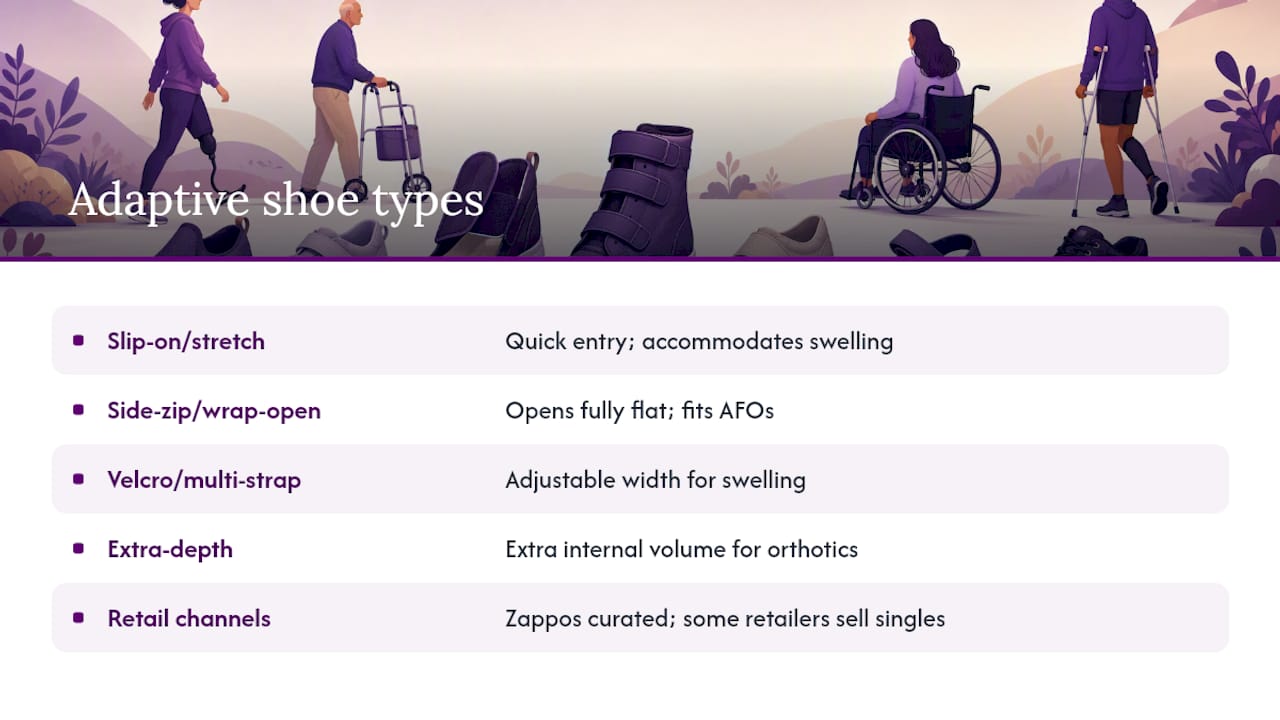
Slip-on and stretch-entry shoes are the simplest option for people who need quick, low-effort dressing. Crocs, for example, are widely used in clinical and recovery settings because of their wide opening, lightweight build, and easy-clean material. They’re not a medical device, but their design naturally accommodates swelling and limited mobility.
Side-zip and wrap-open shoes open completely flat, making them ideal for wheelchair users or anyone who can’t lift their foot to a standard height. Billy Footwear built its entire line around this concept: a zipper runs around the perimeter of the shoe, letting the upper fold down so the foot slides in from the top. This design works well for people with AFOs or significant ankle stiffness.
Velcro and multi-strap shoes give users adjustable fit across the width of the foot, which matters when swelling fluctuates throughout the day. Propét specializes in this category, offering extra-depth, wide-width options with multiple strap configurations that physical therapists and podiatrists frequently recommend.
Extra-depth orthotic-friendly shoes prioritize internal volume. Adidas has introduced adaptive elements in select lines, and Nike’s FlyEase technology uses a wrap-around zipper and flexible heel to allow hands-free entry, a design that earned recognition from occupational therapists working with patients who have limited hand function.
Zappos Adaptive isn’t a shoe type but a retail channel worth knowing. It’s a dedicated section of the Zappos platform that curates adaptive footwear from multiple brands, filters by closure type and condition, and offers free returns, which matters when you’re fitting shoes with orthotics and can’t always predict what will work.
For amputees or single-limb orthotic users, some retailers support single-shoe purchases so you’re not paying for a pair when you only need one.
Who benefits most from adaptive footwear?
Adaptive footwear helps a wide range of people, from those managing chronic conditions to those in short-term recovery. The common thread is that standard footwear creates a barrier, whether to safety, comfort, or independence.
People with diabetes: Neuropathy reduces sensation, making pressure points dangerous. Extra depth, seamless interiors, and condition-specific footwear guidance from FootHealthFacts all point toward protective, accommodating designs.
People with arthritis: Swelling, joint pain, and reduced grip strength make standard lace-up shoes painful and difficult. The Arthritis Foundation’s shoe guidance specifically calls out easy closures and removable insoles.
Clinical note: Medicare covers therapeutic shoes and inserts for eligible beneficiaries with diabetes when prescribed by a Medicare-enrolled physician and supplied by a Medicare-enrolled provider. This is a meaningful coverage pathway for one of the largest user groups.
The United Spinal Association also provides peer support and resource guidance for people navigating mobility equipment choices, including footwear.
Where can you buy adaptive footwear in the U.S.?
Adaptive footwear is more widely available than most people realize. The challenge is knowing where to look and what to ask for.
Common U.S. buying channels include:
Nonprofit resource directories like the United Spinal Association, which can point you toward vetted retailers and peer recommendations
For insurance coverage, Medicare’s therapeutic shoe program is the primary pathway for eligible people with diabetes. Private insurance coverage varies widely; always call your insurer before purchasing.
If you’re also navigating dressing challenges beyond footwear, the Fracture-club guide to dressing after a broken bone or surgery covers complementary clothing solutions that work alongside adaptive shoes.
What materials hold up best in adaptive shoes?
Material choice affects both durability and function. The right material depends on how the shoe will be used and what the wearer’s foot needs.
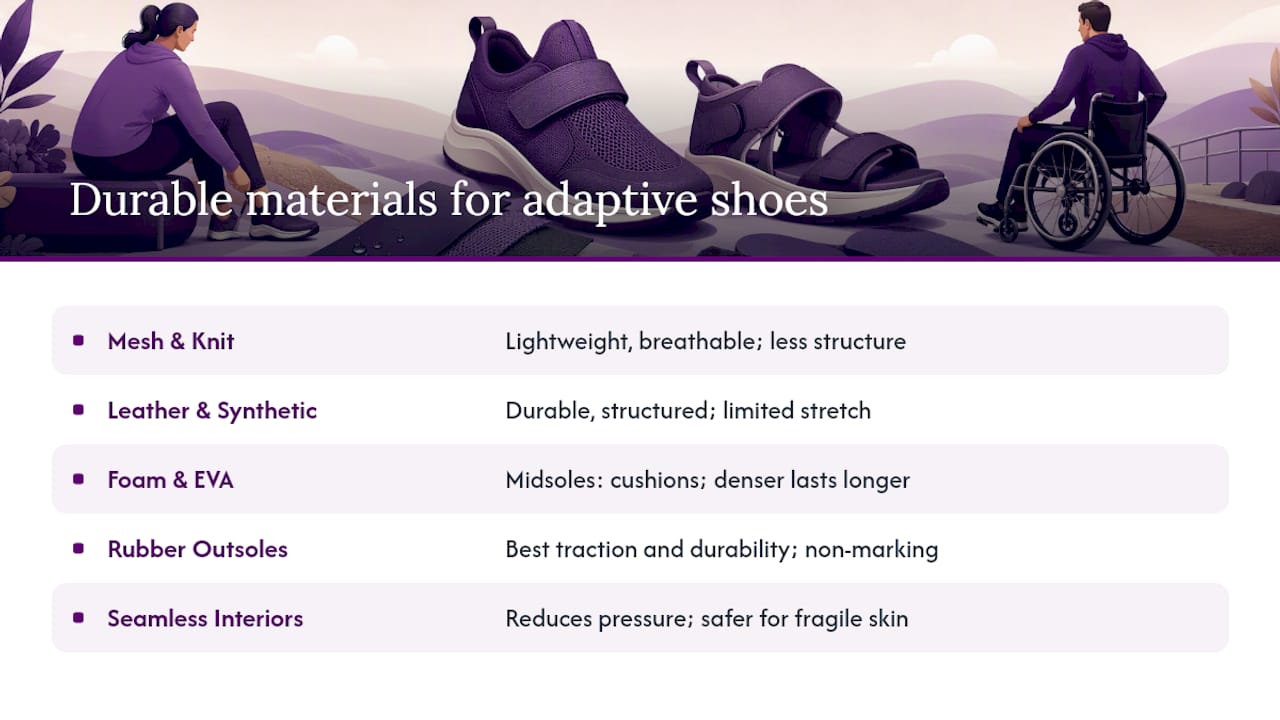
Mesh and knit uppers are lightweight and breathable, making them comfortable for extended wear. They stretch to accommodate swelling but offer less structural support than firmer materials. Good for mild mobility challenges and warm climates.
Leather and synthetic leather provide more structure and durability. They hold their shape under daily use and clean easily, which matters for people managing wound care or skin sensitivity. The tradeoff is less stretch, so sizing and depth become more critical.
Foam and EVA midsoles cushion impact and reduce pressure on sensitive areas. EVA (ethylene-vinyl acetate) is lightweight and widely used in therapeutic footwear. Denser foam lasts longer but may feel firmer underfoot.
Rubber outsoles offer the best traction and durability. Look for a non-marking, textured rubber sole for indoor and outdoor use. Thin or smooth outsoles wear quickly and reduce the anti-slip benefit that makes adaptive shoes safer.
Seamless or minimal-seam interiors use bonded or welded construction rather than stitched seams. This matters most for people with neuropathy or fragile skin, where even a small seam can cause a pressure ulcer over time.
For injury prevention and long-term wear, pairing durable outsoles with a supportive midsole is the combination that holds up across different surfaces and activity levels.
Does Medicare or insurance cover adaptive footwear?
Medicare Part B covers therapeutic shoes and inserts for eligible beneficiaries with diabetes under a specific set of conditions. Coverage includes one pair of custom-molded shoes with inserts, or one pair of extra-depth shoes, per calendar year. To qualify, a Medicare-enrolled physician must certify the medical necessity, and the shoes must be supplied by a Medicare-enrolled provider.
This coverage pathway is narrow but real. The most common barriers are supplier enrollment status and documentation requirements. If you’re navigating this, ask your podiatrist or primary care physician whether they participate in the Medicare therapeutic shoe program before assuming coverage applies.
Private insurance coverage for adaptive footwear varies by plan and diagnosis. Some plans cover orthotics but not the shoes themselves. Others require a letter of medical necessity. Always verify before purchasing.
This is general information, not medical or insurance advice. Confirm current eligibility rules and coverage details directly with Medicare or your insurer.
What does adaptive footwear cost?
Adaptive shoes range from around $40 for basic slip-on styles to $300 or more for custom-molded therapeutic shoes. Most well-designed adaptive options from established brands fall in the $80–$180 range.
Several factors push the price up or down:
Custom vs. off-the-shelf: — Custom-molded shoes prescribed for diabetic foot care are significantly more expensive but may be partially covered by Medicare.
If budget is a concern, start with an off-the-shelf extra-depth shoe from a brand like Propét, which offers strong orthotic compatibility at a mid-range price point. Upgrade to custom or specialty options only if standard sizing doesn’t accommodate your needs.
Key Takeaways
Adaptive footwear is purpose-built for people with mobility challenges, chronic foot conditions, or temporary injuries, and choosing the right pair starts with fit, function, and clinician input.
Point | Details |
Core definition | Adaptive shoes use extra depth, adjustable closures, and wide openings to support safe, independent movement. |
Who benefits most | Older adults, people with diabetes or arthritis, stroke survivors, AFO users, and post-surgical recovery patients all have strong reasons to consider adaptive footwear. |
Key features to prioritize | Look for removable insoles, anti-slip soles, seamless interiors, and closures you can manage with your available hand function. |
Medicare coverage | Medicare Part B covers therapeutic shoes for eligible people with diabetes; a Medicare-enrolled physician must certify need and a Medicare-enrolled supplier must provide the shoes. |
Fracture-club complement | Fracture-club’s adaptive recovery clothing, including magnetic-zipper pants and easy-on/off tops, pairs directly with adaptive footwear for a full dressing solution during injury recovery. |
Why adaptive footwear is only half the picture
Adaptive footwear gets a lot of attention, and it deserves it. But here’s what most guides miss: the foot is rarely the only dressing challenge during recovery. Someone wearing an AFO-compatible shoe still has to get pants over that brace. Someone with post-surgical swelling in their ankle is often dealing with the same swelling in their lower leg, which means standard waistbands and leg openings create the same problem as standard shoes.
The recovery toolkit works best when footwear and clothing solve the problem together. Fracture-club’s focus on adaptive clothing for injury recovery, including side-opening pants and magnetic closures, came from exactly this gap. Adaptive shoes give you the foundation. Adaptive clothing handles everything above the ankle.
If you’re helping someone build out a full recovery setup, the Fracture-club guide on leg cast clothing solutions is worth reading alongside any footwear research. The two categories complement each other in ways that aren’t obvious until you’re in the middle of a recovery.
Fracture-club adaptive clothing works alongside your adaptive shoes
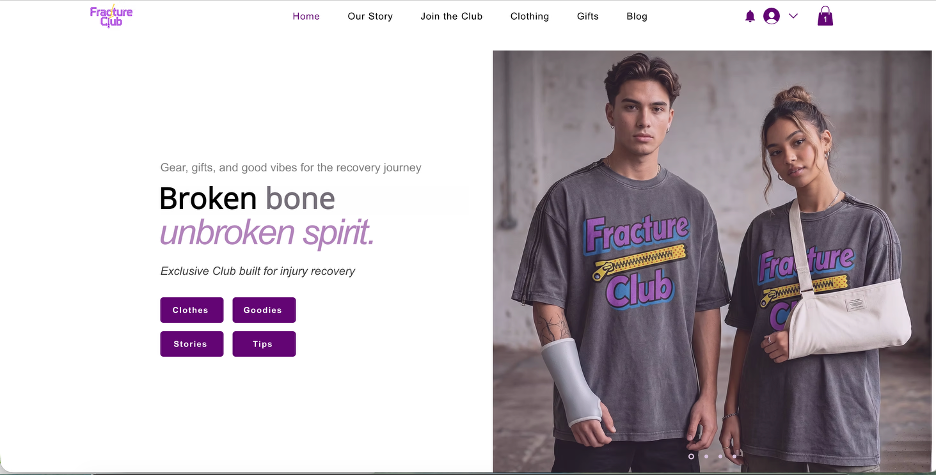
Adaptive footwear solves the shoe problem. Getting dressed from the ankle up is a separate challenge, and that’s exactly where Fracture-club comes in. Fracture-club’s recovery clothing is built for people wearing casts, braces, or dealing with post-surgical swelling: side magnetic zippers that open fully, wide leg openings that clear hardware, and soft fabrics that don’t irritate sensitive skin.
[
](fracture-club.com)
The adaptive recovery pants with side magnetic zippers are designed to work with the same AFOs and braces your adaptive shoes accommodate. You don’t have to choose between function and feeling like yourself during recovery.
Easy on/off with full side-zip opening for casts and braces
Magnetic closures manageable with limited hand function
Machine-washable and durable for daily recovery wear
Pairs naturally with adaptive footwear for a complete dressing solution
Browse the full recovery clothing line at fracture-club.com or reach out through the inquiry page for sizing help or custom questions.
Trusted sources and further reading
Recommended
Comments