
What Does Bone Remodeling Mean for Your Health?
- T. Armstrong

- Jul 5
- 8 min read
Bone remodeling is defined as the continuous, lifelong process by which your body removes old bone tissue and replaces it with new bone. Understanding what does bone remodeling mean is more than a biology lesson. It explains why your bones stay strong after a fracture, why osteoporosis develops, and what you can actually do to protect your skeleton. The adult skeleton replaces roughly 10% of its mass every year, meaning your entire skeleton renews itself approximately every 10 years. That rate tells you just how active and responsive your bones really are.
What does bone remodeling mean at the cellular level?
Bone remodeling is the coordinated cycle of bone removal and bone formation, driven by three specialized cell types: osteoclasts, osteoblasts, and osteocytes. The process runs through five sequential phases: activation, resorption, reversal, formation, and quiescence. Each phase has a distinct job, and they must happen in the right order for your skeleton to stay healthy.
Here is how each phase works:
Activation. A signal, often from osteocytes detecting microdamage or mechanical strain, triggers the remodeling cycle to begin. Osteocytes act as the skeleton’s internal sensors, detecting strain or damage and regulating remodeling via RANKL signaling.
Resorption. Osteoclasts attach to the bone surface and dissolve old or damaged bone over a period of two to four weeks. They create microscopic pits called Howship’s lacunae as they work.
Reversal. Osteoclasts undergo programmed cell death. A cement line forms on the excavated surface, preparing it for new bone to bond. This reversal phase is critical for long-term integrity of the repaired area.
Formation. Osteoblasts move in and lay down a new protein matrix called osteoid. This matrix then mineralizes over several weeks, becoming hard, mature bone.
Quiescence. The site returns to a resting state. Some osteoblasts become embedded in the new bone and transform into osteocytes, ready to sense the next round of damage.
The RANKL/OPG signaling system acts as the master switch for this cycle. RANKL promotes osteoclast activity, while OPG blocks it. When this balance tips, disease follows.
Pro Tip: If you are recovering from a fracture, ask your doctor whether your calcium and vitamin D levels have been checked. Both nutrients are required for the formation phase to complete properly.
Why does bone remodeling matter for long-term bone health?
Bone remodeling maintains structural integrity by replacing microcracks before they grow into full fractures. Without this process, everyday stress would accumulate in your skeleton until something broke. The biological and clinical significance of remodeling cannot be overstated.
Key reasons why healthy remodeling protects you:
Fracture prevention. Remodeling targets and repairs microdamage caused by normal physical activity, keeping bones strong over decades.
Mineral regulation. The process releases calcium and phosphate into the bloodstream when the body needs them, supporting heart, nerve, and muscle function.
Structural adaptation. Per Wolff’s Law, bone adapts structurally in response to mechanical loads. Bones that carry more weight grow denser; bones that are unused thin out.
Disease prevention. When osteoclast and osteoblast activity falls out of balance, conditions like osteoporosis or osteopetrosis develop. Estrogen deficiency causes osteoclast dominance and net bone loss, which is why postmenopausal women face elevated fracture risk.
Peak bone mass, reached during adolescence and early adulthood, sets the baseline for the rest of your life. Research shows that 10% higher peak bone mass can delay osteoporosis onset by up to 13 years. That finding reframes bone health as something you build early and protect continuously, not something you address only after a diagnosis.
“Bone is not a static scaffold. It is a living tissue in constant dialogue with your hormones, your diet, and your physical activity. When that dialogue breaks down, fractures and disease follow. When it is supported, your skeleton can remain strong well into old age.”
Understanding the significance of bone remodeling gives you a clear reason to act on lifestyle habits before problems appear.
What factors affect the bone remodeling process?
Three categories of factors directly influence how well your remodeling cycle runs: nutrition, hormones, and physical activity. Each one affects a different phase of the cycle, and neglecting any one of them slows the whole process down.

Nutrition
Calcium and vitamin D are the two most critical nutrients for bone remodeling. Calcium provides the raw material for mineralization during the formation phase. Vitamin D controls how much calcium your gut absorbs. Deficiencies in either nutrient impair the completion of the remodeling cycle, leaving newly formed bone soft and prone to fracture. Protein also matters. Your body uses amino acids to build the osteoid matrix that osteoblasts lay down. Learn more about protein’s role in bone healing if you are currently recovering from an injury.
Hormones
Estrogen suppresses osteoclast activity. When estrogen drops after menopause, resorption accelerates and bone loss follows.
Parathyroid hormone (PTH) regulates calcium levels in the blood. Chronically elevated PTH pulls calcium from bone, tipping the balance toward resorption.
Testosterone supports bone density in men. Low testosterone accelerates bone loss in older males, though at a slower rate than estrogen loss in women.
Physical activity
Mechanical loading stimulates osteocytes to send remodeling signals throughout the skeleton. Without physical stress, those signals diminish and bone density falls. Weight-bearing exercises like walking, jogging, resistance training, and stair climbing are the most effective at triggering this response. A sedentary lifestyle does the opposite. Astronauts in zero gravity lose bone mass rapidly because the absence of mechanical load silences osteocyte signaling. You do not need to be an athlete to protect your bones. Consistent, moderate weight-bearing exercise is enough to keep the remodeling cycle running at a healthy pace.
Pro Tip: Combine resistance training with adequate calcium intake for a compounding effect. Exercise stimulates the remodeling signal; calcium gives osteoblasts the material to complete the job.
How does bone remodeling support fracture recovery?
Bone remodeling plays a direct role in healing after a fracture. When a bone breaks, the body first lays down a soft, disorganized tissue called woven bone to bridge the gap quickly. Remodeling then converts that woven bone into mature lamellar bone, which is organized, dense, and strong. This conversion is what gives a healed fracture its full mechanical strength.
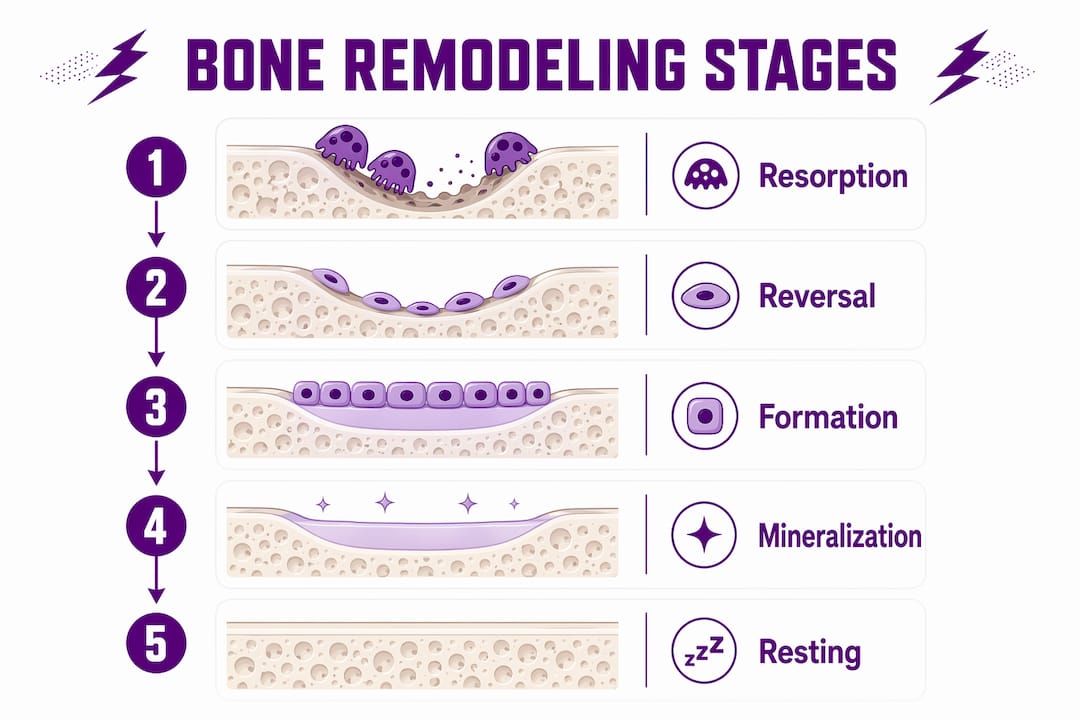
The remodeling that follows a fracture happens in Basic Multicellular Units (BMUs), which are small cellular teams of osteoclasts and osteoblasts working together in a focused area. BMUs allow the body to target repair precisely where it is needed rather than remodeling the entire skeleton at once. This localized approach is efficient, but it also means that anything disrupting the remodeling cycle, such as poor nutrition or hormonal imbalance, directly slows fracture healing.
Healing stage | Remodeling role | Approximate timeframe |
Woven bone formation | Rapid bridging of fracture gap | Weeks 2–6 post-fracture |
Early remodeling | BMUs begin replacing woven bone | Weeks 6–12 post-fracture |
Lamellar bone maturation | Organized, dense bone replaces woven bone | Months 3–12 post-fracture |
Long-term remodeling | Bone reshapes to match original structure | Up to 2 years post-fracture |
The reversal phase is especially important during fracture recovery. The cement line deposited after osteoclast activity ensures new bone matrix bonds strongly to existing bone. Without a proper reversal phase, the new bone may not integrate well, leaving the healed site weaker than it should be. Supporting your body through good nutrition and appropriate physical activity gives each phase of this process the best chance to complete correctly. A practical starting point is reviewing how diet affects fracture recovery to align your eating habits with what your bones need most during healing.
Key Takeaways
Bone remodeling is a continuous, five-phase biological cycle that repairs microdamage, regulates minerals, and rebuilds bone after fractures, driven by the coordinated activity of osteoclasts, osteoblasts, and osteocytes.
Point | Details |
Remodeling never stops | Your skeleton replaces roughly 10% of its mass every year through continuous remodeling. |
Five phases must complete in order | Activation, resorption, reversal, formation, and quiescence each have a distinct role in healthy bone renewal. |
Imbalance causes disease | Osteoclast dominance from estrogen deficiency leads to osteoporosis and elevated fracture risk. |
Nutrition and exercise are non-negotiable | Calcium, vitamin D, and weight-bearing activity directly fuel the remodeling cycle. |
Fracture healing depends on remodeling | BMUs convert woven bone into strong lamellar bone, a process that can take up to two years. |
What I have learned from watching people heal
Most people I talk to during recovery are surprised to learn that their bones are not passive. They are not just waiting to knit back together. They are actively rebuilding, cell by cell, in a process that responds to every meal you eat and every step you take. That realization changes how people approach recovery. It shifts the mindset from “waiting to heal” to “actively supporting healing.”
The most common misconception I encounter is that bones are like concrete: hard, fixed, and either intact or broken. The reality is the opposite. Bone is one of the most metabolically active tissues in your body. When you understand that, you stop treating recovery as passive rest and start treating it as an active process that you can influence.
The other thing I have seen is how much the emotional side of recovery affects the physical side. Stress hormones like cortisol suppress bone formation. Isolation reduces physical activity. Both slow remodeling. That is why community and comfort during recovery are not soft extras. They are physiologically relevant. Wearing clothes that fit over a cast, moving without pain, feeling like yourself again: these things reduce stress and keep you moving. And movement keeps your remodeling cycle running.
My honest advice is this: do not wait for a diagnosis to care about your bones. Learn the cycle, support it with food and movement, and get help when something breaks. Your skeleton is already doing the work. Give it what it needs.
— Fracture
Recovery wear that works with your healing body
Healing from a fracture means your body is running the remodeling cycle around the clock. The last thing you need is clothing that fights you every time you get dressed.
Fracture-club designs adaptive recovery wear specifically for people healing from bone injuries. The adaptive recovery pants feature magnetic side zippers that open wide enough to fit over casts and braces without twisting or pulling. The adaptive recovery sweatshirt is built for upper limb injuries, letting you dress independently even with a cast or sling. A portion of every purchase supports the Bone Health & Osteoporosis Foundation. Your recovery matters, and Fracture-club is built around that belief.
FAQ
What does bone remodeling mean in simple terms?
Bone remodeling is the process your body uses to remove old or damaged bone and replace it with new, healthy bone. It runs continuously throughout your life and keeps your skeleton strong and functional.
How long does the bone remodeling cycle take?
The full remodeling cycle varies by location in the skeleton, but the resorption phase alone typically lasts two to four weeks. Complete renewal of the adult skeleton takes approximately 10 years.
What triggers bone remodeling to start?
Osteocytes detect microdamage or mechanical strain in bone and send chemical signals, including RANKL, that activate osteoclasts to begin the resorption phase. Physical activity and hormonal changes are the most common triggers.
How does osteoporosis relate to bone remodeling?
Osteoporosis develops when osteoclast activity outpaces osteoblast activity, resulting in net bone loss over time. Estrogen deficiency is the most common cause of this imbalance, particularly in postmenopausal women.
Can you support bone remodeling during fracture recovery?
Yes. Adequate calcium and vitamin D intake, appropriate weight-bearing activity as cleared by your doctor, and hormonal balance all support the remodeling cycle that converts woven bone into strong lamellar bone after a fracture.
Recommended
Comments