
Choosing Bone Health Supplements Wisely in 2026
- T. Armstrong

- 6 days ago
- 8 min read

Choosing bone health supplements wisely means prioritizing evidence-backed nutrients like calcium, vitamin D3, vitamin K2, and magnesium to fill dietary gaps rather than replace food. Most adults over 50 fall short of the 1,200 mg daily calcium target from diet alone, making targeted supplementation a practical necessity. The challenge is not whether to supplement. The challenge is knowing which nutrients matter, which product forms actually absorb, and how to avoid the common mistakes that turn a good intention into a health risk.
What nutrients are critical for bone health?
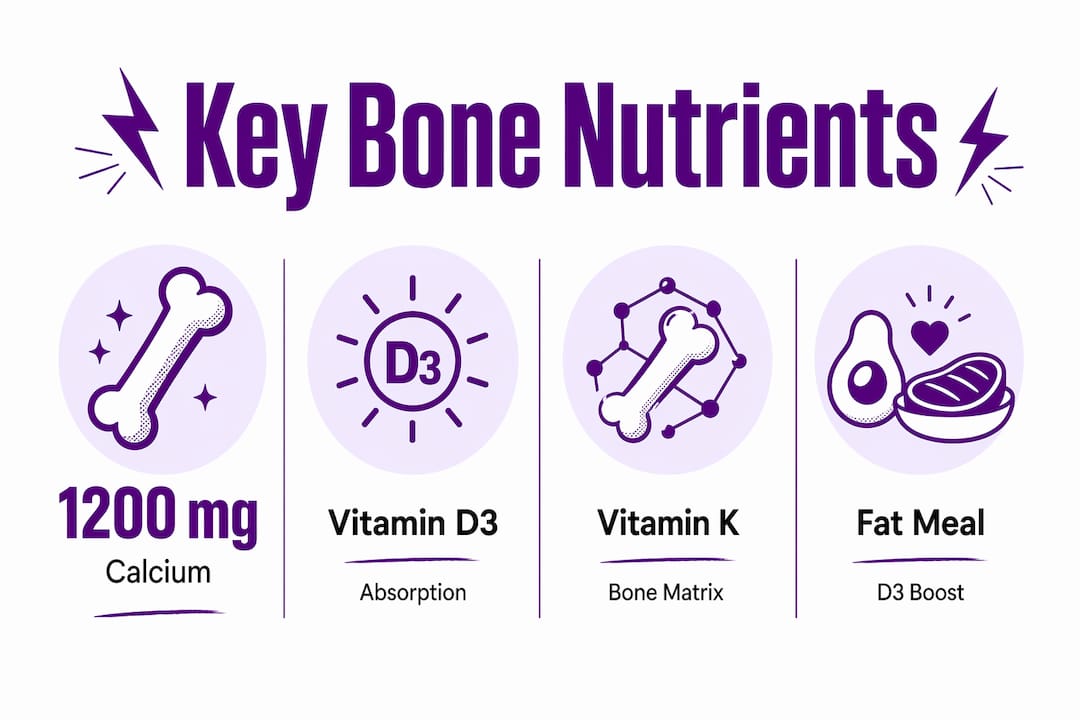
Calcium is the primary mineral in bone tissue. Adults over 50 need a total of 1,200 mg per day from food and supplements combined. Typical dietary intake lands between 600 and 800 mg, so a supplement providing 400–600 mg fills the gap without pushing into excess territory.
Vitamin D3 is what makes calcium absorption possible. Without adequate D3, your gut absorbs only a fraction of the calcium you consume. Optimal serum 25-hydroxyvitamin D levels for bone health fall between 30–50 ng/mL, typically requiring 800–2,000 IU of vitamin D3 daily. That range varies by person, which is why blood testing matters before you pick a dose.
Vitamin K2 plays a role that most people overlook. It activates proteins that direct calcium into bones rather than letting it deposit in arteries. Magnesium activates vitamin D and supports the bone matrix itself. Learn more about magnesium’s specific role in bone repair and recovery.
The key insight here is synergy. These four nutrients work as a system. Taking high-dose calcium without adequate K2, D3, and magnesium can actually increase arterial calcification risk instead of building bone. That is the most important bone health nutrition tip most supplement labels never mention.
Calcium: 400–600 mg supplemental per day for adults 50+, combined with dietary sources
Vitamin D3 (cholecalciferol): 800–2,000 IU daily, adjusted by blood test results
Vitamin K2 (MK-7 form): supports calcium direction into bone tissue
Magnesium: activates vitamin D and supports bone matrix structure
Pro Tip: Take your vitamin D3 with a meal that contains fat. D3 is fat-soluble, so absorption increases significantly when paired with dietary fat.
How do you assess your dietary gaps before supplementing?
Start with food before you open a supplement bottle. Dairy products, fortified plant milks, leafy greens, and canned fish with bones all contribute meaningful calcium. If you eat two to three servings of calcium-rich foods daily, your dietary intake likely sits in the 600–800 mg range. A supplement of 400–500 mg then brings you to the 1,200 mg target without overshooting.
Vitamin D is harder to get from food alone. Fatty fish, egg yolks, and fortified foods provide some, but rarely enough to reach optimal serum levels. Sun exposure helps, but factors like latitude, skin tone, sunscreen use, and age all reduce how much D3 your skin produces. A simple blood test for 25-hydroxyvitamin D gives you a real number to work with. Check your bone health lab results to understand what those numbers mean for your supplement plan.
Here is a practical sequence for assessing your gaps before buying anything:
Log your diet for three days. Track calcium-rich foods and estimate your daily intake using a nutrition database like the USDA FoodData Central.
Request a 25-hydroxyvitamin D blood test. Ask your doctor at your next annual visit. This single test personalizes your D3 dose more accurately than any label recommendation.
Review your magnesium intake. Nuts, seeds, legumes, and whole grains are the best dietary sources. If your diet is low in these, a supplement of 200–400 mg of magnesium glycinate or citrate is a reasonable addition.
Check for vitamin K2 in your diet. Fermented foods like natto are the richest source. Most Western diets are low in K2, making a supplement of 90–200 mcg of MK-7 worth considering.
Calculate your total supplement need. Subtract your estimated dietary intake from the recommended targets. Supplement only the gap.
This food-first approach reduces your supplement load, lowers cost, and avoids the risk of overshooting nutrient thresholds.
How do you choose high-quality bone supplements at retail?
The supplement aisle can feel like a maze. Labels make bold claims, and the regulatory environment in the United States does not require pre-market proof of efficacy. Knowing what to look for in supplements separates products that deliver from those that just look good on a shelf.

The first red flag is a proprietary blend. Proprietary blend labels list ingredients without disclosing exact amounts, making it impossible to know whether you are getting a therapeutic dose or a trace amount. Always choose products with fully disclosed ingredient quantities.
Form matters as much as dose. Calcium citrate absorbs better than calcium carbonate for older adults and anyone taking acid-reducing medications like proton pump inhibitors. Calcium carbonate requires stomach acid to break down. Calcium citrate does not. For vitamin D, choose D3 (cholecalciferol) over D2 (ergocalciferol). D3 raises serum levels more effectively. For vitamin K2, the MK-7 form has a longer half-life in the body than MK-4, meaning it stays active longer per dose.
Avoid proprietary blends. Full ingredient disclosure is non-negotiable for evaluating a product.
Choose calcium citrate over carbonate if you are over 60 or take acid-lowering medications.
Split calcium doses. Doses above 600 mg per serving reduce absorption and increase gastrointestinal side effects. Take 500 mg at one meal and 500 mg at another.
Look for third-party certifications. USP and NSF seals confirm that label accuracy and purity have been independently verified. They do not confirm clinical effectiveness, but they do confirm you are getting what the label says.
Avoid excessive percentages. Products showing over 200% of the Daily Value for any nutrient without clinical justification are a warning sign, not a selling point.
Pro Tip: When comparing two products with similar ingredients, choose the one with the shorter ingredient list. Fewer fillers, binders, and additives generally mean a cleaner product.
Feature | What to look for | What to avoid |
Calcium form | Citrate (older adults, low acid) | Carbonate if on acid-reducing meds |
Vitamin D form | D3 (cholecalciferol) | D2 (ergocalciferol) |
Vitamin K2 form | MK-7 | MK-4 only |
Label transparency | Full ingredient disclosure | Proprietary blends |
Third-party testing | USP or NSF certified | No certification listed |
What are the safety risks of bone health supplementation?
More calcium is not better. Excess calcium without balanced K2, D3, and magnesium can lead to arterial calcification rather than bone mineralization. This is one of the most misunderstood risks in bone health supplementation, and it is why taking a single high-dose calcium supplement without the supporting nutrients is a problem.
Drug interactions are a real concern that many people underestimate. Patients often fail to disclose supplements to their doctors or pharmacists, which creates risk when those supplements interact with osteoporosis medications or blood thinners. Calcium can reduce the absorption of certain antibiotics and thyroid medications. Vitamin K2 can interfere with warfarin. Always bring a complete list of every supplement you take to every medical appointment.
Supplements are necessary for bone health support, but they cannot reverse osteoporosis on their own. When a bone density scan shows a T-score at or below -2.5, pharmacological treatment is required alongside supplementation. Supplements fill nutritional gaps. They do not replace medication when clinical osteoporosis is present.
Annual review of your supplement regimen is a practice worth building into your routine. Blood tests, bone density scans, and changes in your diet or medications all affect what you need. What worked two years ago may not be the right plan today. Understanding what bone fragility means for your personal risk level helps you have more informed conversations with your care team.
Key Takeaways
Choosing bone health supplements wisely requires matching the right nutrient forms and doses to your actual dietary gaps, confirmed by blood testing and guided by clinical thresholds.
Point | Details |
Target total calcium intake | Aim for 1,200 mg/day total from food and supplements combined, not supplements alone. |
Test before you dose | A 25-hydroxyvitamin D blood test personalizes your D3 dose far better than any label default. |
Form determines absorption | Calcium citrate outperforms carbonate for older adults; choose D3 over D2 and MK-7 over MK-4. |
Nutrient synergy is non-negotiable | Calcium without K2, D3, and magnesium can calcify arteries instead of building bone. |
Supplements have limits | A T-score at or below -2.5 requires pharmacological treatment. Supplements alone are not enough. |
What I have learned about supplementing for bone health
Most people approach bone supplements the way they approach vitamins: more is safer, and a higher number on the label means a better product. That thinking causes real harm. The patients I have seen struggle most with bone health are often the ones who took calcium supplements for years without ever testing their vitamin D levels or pairing calcium with K2. They did everything they thought was right and still ended up with poor outcomes.
The single most useful shift is moving from a supplement-first mindset to a test-and-fill mindset. You do not need a cabinet full of bottles. You need a blood test, an honest look at your diet, and two or three well-chosen products with clean labels and verified third-party testing. Timing matters too. Taking calcium with meals improves absorption. Taking D3 with a fat-containing meal does the same. These small adjustments cost nothing and make a measurable difference.
Supplements support bone health. They do not cure it. When someone has been diagnosed with osteoporosis, the conversation about medication is not optional. Supplements are part of the plan, not the whole plan. The most empowering thing you can do is understand that distinction clearly, then use the 2026 bone health screening guidelines to stay ahead of the curve.
— Fracture
Recovery support from Fracture-club
Bone health is about more than supplements. When a fracture happens, the recovery process touches every part of daily life, including getting dressed.

Fracture-club designs adaptive recovery pants with magnetic side zippers that make dressing possible even with a cast or brace. The easy-on recovery sweatshirt is built for upper limb injuries, so you do not have to wrestle with sleeves when your arm is healing. A portion of every purchase supports the Bone Health & Osteoporosis Foundation. If you have questions about which products fit your recovery situation, the Fracture-club inquiry page connects you with personalized assistance.
FAQ
What is the recommended daily calcium intake for adults over 50?
Adults over 50 should target 1,200 mg of total daily calcium from food and supplements combined. Since typical dietary intake provides only 600–800 mg, a supplemental 400–600 mg fills the gap.
Why is vitamin D3 better than vitamin D2 for bone health?
Vitamin D3 (cholecalciferol) raises serum 25-hydroxyvitamin D levels more effectively than D2 (ergocalciferol). Testing your blood level first helps you choose the right dose, typically 800–2,000 IU daily.
What does a third-party certification like USP or NSF actually guarantee?
USP and NSF certifications confirm that a supplement contains what the label states and is free from harmful contaminants. They do not confirm that the product will improve bone density or prevent fractures.
Can supplements alone treat osteoporosis?
Supplements cannot reverse osteoporosis when a bone density scan shows a T-score at or below -2.5. Pharmacological treatment is required at that stage, with supplements serving as necessary nutritional support alongside medication.
Why should I split my calcium supplement dose?
Calcium absorption decreases when a single dose exceeds 500–600 mg. Splitting your daily supplement into two smaller doses taken with separate meals improves absorption and reduces the risk of gastrointestinal side effects.
Recommended
Comments