
Hospital-Approved Gift Items: Safe, Useful Ideas for Patients
- T. Armstrong

- 7 days ago
- 9 min read
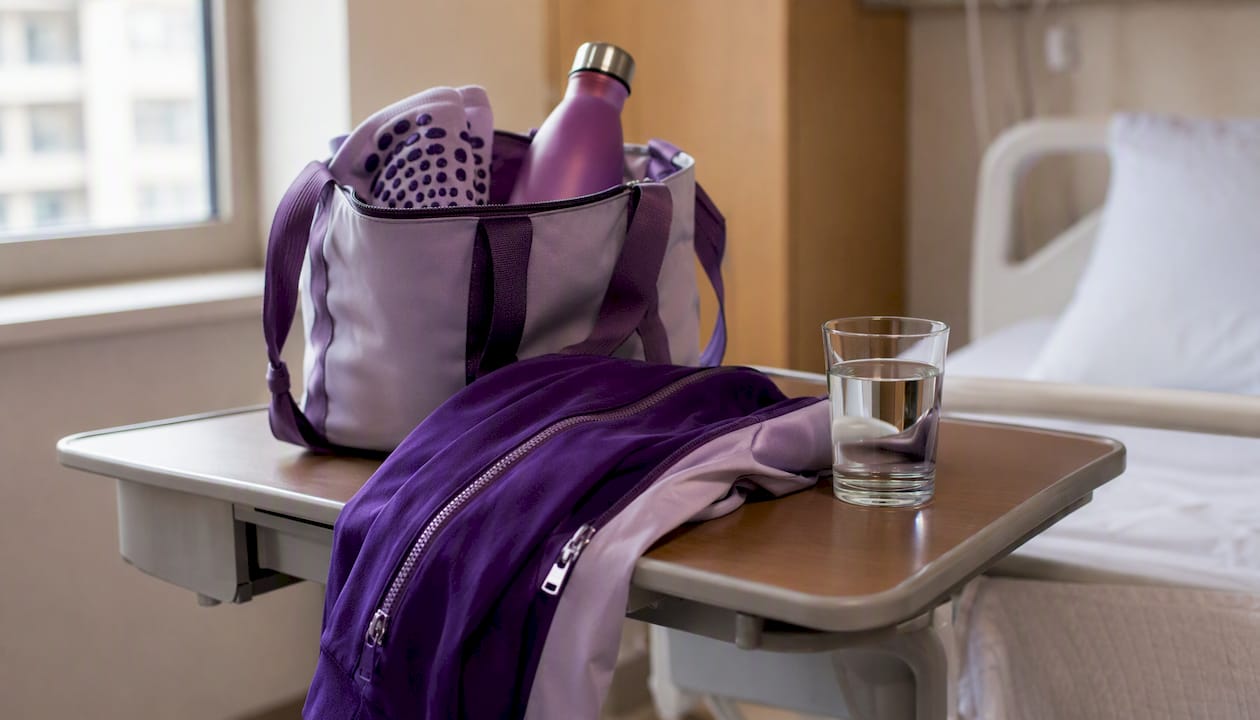
Hospital-approved gift items typically fall into these categories: personal care items, comfortable clothing, sealed snacks, phone chargers, cards and handwritten notes, digital gifts, and Mylar balloons. Before you buy or bring anything, three rules apply every time.
Check the specific unit’s policy first. ICU, NICU, oncology, and isolation rooms often have stricter rules than general wards.
Avoid fresh flowers, latex balloons, and strong scents in any high-risk unit. These can trigger allergies or introduce airborne spores to patients with compromised immune systems.
Keep gifts low-value and practical if the patient is a Medicare or Medicaid beneficiary. The OIG’s guidance on gifts and inducements defines “inexpensive” as no more than $10 per item and no more than $50 per patient annually.
Pro Tip: Before you head to the hospital, call the nursing station or ask the hospital gift shop. They know exactly what the unit allows that day, including any active infection-control protocols.
Key Takeaways
Hospital-approved gifts work best when they are practical, low-value, and cleared against the specific unit’s policy before you buy.
Point | Details |
Check unit policy first | ICU, NICU, and oncology wards have stricter rules than general floors; call the nursing station before buying. |
Avoid high-risk items | Fresh flowers, latex balloons, strong scents, and unsealed food are commonly banned for infection-control reasons. |
Keep gifts under $10 per item | OIG guidance sets $10 per item and $50 annually as the inexpensive threshold for Medicare/Medicaid beneficiaries. |
Prioritize practical over decorative | Extension cords, grip socks, tissues, and adaptive clothing rank higher in usefulness than flowers or balloons. |
Fracture-club adaptive clothing | Easy-on/off pants and sweatshirts with magnetic closures are hospital-friendly gifts for patients with casts or braces. |
Table of Contents
What are hospital-approved gift items, by category?
CaringBridge’s hospital gift guide consistently ranks practical, high-utility items above decorative ones. Here is what works, and why.
Personal care
Unscented lotion, lip balm, and dry shampoo restore small daily rituals that hospital routines strip away.
Soft tissues (a higher-quality brand than the hospital provides) are used constantly and always welcome.
Deodorant and hair ties fall into the same category: easy to overlook, genuinely appreciated.
Comfort items
Grip socks or fuzzy slippers reduce fall risk and keep feet warm on cold floors.
A small, lightweight blanket adds personal warmth without taking up much space.
A supportive travel pillow helps patients who spend long hours sitting upright in bed.
Clothing designed for easy dressing
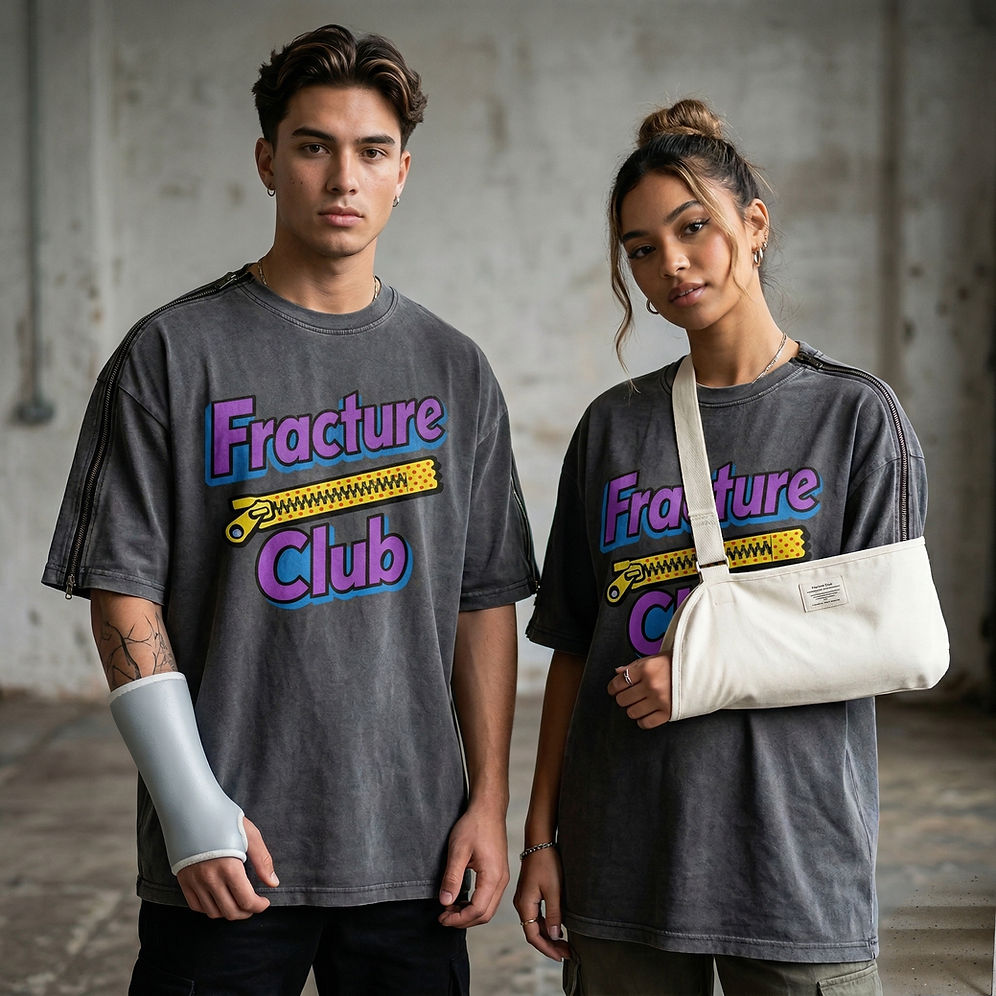
This is where most gift-givers miss an opportunity. Standard pajamas and sweatpants are difficult to put on over a cast, brace, or IV line. Adaptive clothing solves that problem. Fracture-club’s adaptive recovery pants feature side magnetic zippers that open wide enough to dress without removing any medical device. The fabrics are soft and machine-washable, which matters in a hospital setting where hygiene is non-negotiable. For patients with upper-limb injuries, an easy-on sweatshirt with open-side closures does the same job. You can read more about why hospital-to-home clothing matters for patients navigating recovery.
Entertainment
Audible subscription or audiobook gift card — delivered by email, no device required, no infection-control concern.
Amazon Kindle or a preloaded e-reader — compact, quiet, and keeps a patient occupied for days. Gift an e-book directly to their account if they already own a device.
Puzzle books, coloring books, or crosswords — low-tech, no charging required, and easy to set aside between nurse visits.
Practical gear
Extension cord or power strip — hospital outlets are rarely near the bed. This is one of the most-requested items.
Spill-proof water bottle — reduces mess and encourages hydration.
Phone charger or charging cable — a spare is always useful.
Sealed snacks and food
Individually wrapped granola bars, nuts, or crackers are generally safe for general wards. Always confirm dietary restrictions with the care team first, because a well-intentioned food gift can be discarded if it conflicts with the patient’s medical plan.
Cards and decorations
A handwritten card costs almost nothing and carries real emotional weight.
Mylar (non-latex) balloons are the accepted alternative to latex balloons in most hospital units, including those that ban latex entirely.
Which hospital units restrict gifts, and what do they ban?
Some units have rules that go well beyond the general hospital policy. Knowing which ones before you shop saves you from bringing something that gets turned away at the door.
Units with the strictest restrictions:
ICU (Intensive Care Unit) — fresh flowers, latex balloons, and strong fragrances are commonly prohibited. Outside food is often restricted entirely.
NICU (Neonatal Intensive Care Unit) — porous plush toys are frequently banned because they harbor bacteria. Scented items are also off-limits.
Oncology wards — patients undergoing chemotherapy have severely compromised immune systems. Fresh flowers introduce pollen and fungal spores; Holy Cross Health’s visitor guidelines list Mylar balloons, puzzle books, digital subscriptions, and sealed personal-care items as safe alternatives.
Bone marrow transplant and isolation rooms — the most restrictive of all. Some facilities allow only factory-sealed items that can be wiped down.
The infection-control rationale is straightforward. Fresh flowers carry pollen and mold spores. Latex balloons pose an allergy risk. Strong scents can trigger nausea in patients on certain medications. Porous materials like stuffed animals are difficult to sanitize and can carry pathogens into a sterile environment.
On gift value: The OIG’s Special Advisory Bulletin cautions that gifts exceeding $10 per item or $50 annually per Medicare or Medicaid beneficiary risk being classified as inducements. This applies to providers and programs, but it is a useful benchmark for anyone choosing gifts for patients in federally funded care settings.
Pro Tip: For patients in oncology, bone marrow transplant, or isolation units, call the unit’s charge nurse or ask to speak with the patient’s social worker before purchasing anything. They can tell you exactly what is permitted that week.
How do you check a hospital’s rules and deliver gifts safely?
A little coordination upfront prevents a lot of frustration at the door.
Call the hospital’s main operator or patient information desk. Ask for the visitor and gift policy for the specific unit. Many hospitals post this on their website, but calling confirms any recent changes.
Check the hospital website. Search for “visitor policy” or “gift shop” — most major U.S. hospitals publish unit-specific guidelines.
Ask the patient’s nurse or care team about dietary restrictions, allergies, and any active infection-control protocols before bringing food or scented items.
Use the hospital gift shop delivery service when available. Items sold there are pre-screened for compliance, and staff can deliver directly to the room.
Delivery best practices:
Label every package clearly with the patient’s full name, room number, and bed number.
Hand gifts to the bedside nurse when required rather than leaving them unattended.
Keep the bedside area clear. Hospital rooms are small, and clutter creates safety hazards.
For infection-controlled units, bring only factory-sealed items and sanitize your hands before and after handling anything near the patient.
Pro Tip: When you are unsure about any item, send a digital gift instead. An Audible gift card or an Amazon e-book emailed directly to the patient sidesteps every delivery and infection-control concern.
How do you build a hospital-approved care package?
A good care package is not about volume. It is about choosing the right combination for the patient’s specific situation.
Framework:
Assess the patient’s needs: mobility limits, dietary restrictions, unit type, and expected length of stay.
Pick one comfort item, one practical item, and one entertainment item.
Cross-check every item against the unit’s known restrictions.
Package for bedside use: flat, compact, and easy to open without assistance.
Sample packs:
Short-stay adult (1–3 days)
Unscented lip balm and lotion
Phone charger
Puzzle book or crossword
Handwritten card
Long-stay adult (4+ days)
Grip socks and a small blanket
Extension cord
Audible gift card (emailed)
High-quality tissues and dry shampoo
Sealed snacks (confirm dietary restrictions first)
Pediatric
Age-appropriate coloring book and crayons (new, sealed)
Soft grip socks
Small Mylar balloon (check unit policy)
Sealed snack the child likes (confirm with parents and care team)
For NICU patients, check with the organic and low-toxicity gift guide for newborns for ideas that meet strict hygiene standards.
Orthopedic or fracture-recovery pack
Adaptive recovery pants (magnetic side zippers for cast or brace compatibility)
Grip socks
Spill-proof water bottle
Audible subscription or Kindle e-book
Handwritten note
The care package checklist for orthopedic recovery at Fracture-club covers this in more detail, including size guidance for adaptive clothing.
Packaging hygiene: Use a wipeable tote or a clean gift bag. Wrap individual items separately. Include a short handwritten note listing contents so nursing staff can review quickly.
Pro Tip: Favor flat items and small organizers over bulky gift baskets. A bedside table in a hospital room is about the size of a nightstand, and every inch counts.
Why do small, practical gifts often matter most?
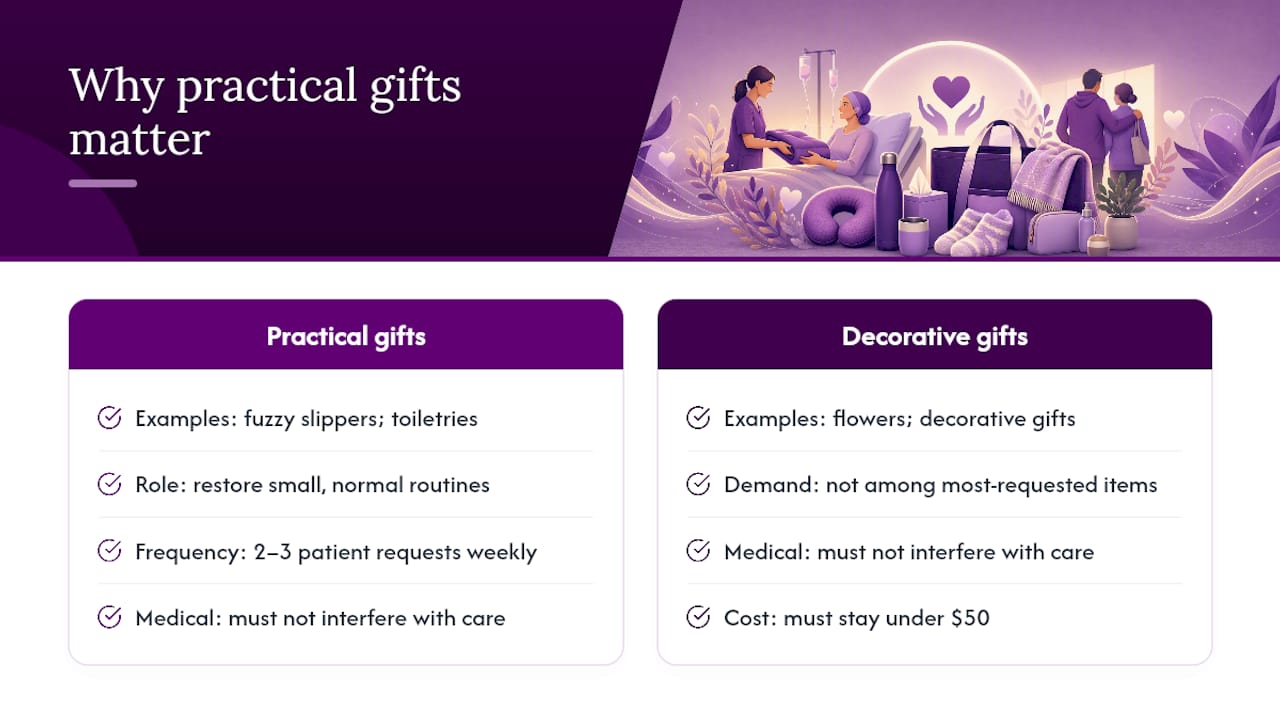
Penn Medicine’s PennHOPES program found that modest items like fuzzy slippers, puzzles, and grooming kits consistently improved patient morale during extended stays. Gifts must stay under $50 and cannot interfere with the medical plan, but within those limits, the emotional return is disproportionate to the cost.
The Philadelphia Inquirer’s reporting on PennHOPES documented the program’s early results: a number of gifts purchased at a moderate total cost, fulfilling two to three patient requests per week. The items were not elaborate. Shaving kits. Fuzzy slippers. Puzzle books. What they shared was a focus on restoring small, normal routines that illness disrupts.
That pattern holds across practical gift guides as well. CaringBridge’s hospital care-package research shows that tissues, deodorant, hair products, and nonperishables like granola bars rank among the most-requested items, not flowers or decorative gifts.
The OIG’s framework reinforces this from a policy angle. Gifts valued at no more than $10 per item and $50 annually per Medicare or Medicaid beneficiary are generally permissible. That ceiling is not a limitation. It is a useful guide: the most meaningful hospital gifts tend to be inexpensive and functional.
Pro Tip: Choose items that let the patient do something independently, whether that is moisturizing their own hands, listening to a book, or getting dressed without asking for help. Autonomy during recovery is underrated.
What should you never bring to a hospital?
Fresh flowers — banned in ICU, NICU, oncology, and isolation units due to pollen and mold spores.
Latex balloons — allergy risk; Mylar balloons are the accepted alternative.
Unsealed or home-cooked food — may conflict with dietary restrictions or infection-control protocols.
Strong fragrances or perfumes — can cause nausea and are prohibited in many units.
Open or used plush toys — porous materials are difficult to sanitize; new and sealed may be acceptable in some pediatric units, but always confirm.
Candles or incense — open flames and strong scents are prohibited in all hospital settings.
Alcohol — not permitted in clinical settings.
Cash or high-value gifts — for Medicare or Medicaid beneficiaries, gifts exceeding $10 per item or $50 annually risk being treated as inducements under OIG guidance.
One note on pediatric units: some allow small, new, sealed plush toys. Always confirm with the unit’s nursing staff before bringing one.
The gifts that actually help, and why most advice gets this wrong
Most hospital gift guides focus on what is allowed. That is the right starting point, but it misses the more useful question: what does the patient actually need right now?
The answer, consistently, is something that helps them feel like themselves. Not a get-well-soon balloon. Not a fruit basket that sits untouched. Something that lets them brush their hair, listen to a story, or get dressed without calling for help.
That is why adaptive clothing is one of the most overlooked categories in hospital gift guides. Visitors think about comfort, and they reach for soft blankets or slippers. Those are good. But a patient who cannot pull on a pair of pants without pain or assistance loses something harder to name. Adaptive clothing with magnetic closures or open-side zippers gives that back. It is practical in a way that a decorative gift simply is not.
[
](https://fracture-club.com/product-page/fracture-club-magnetic-shoulder-zip-tee-injury-recovery-wear)
The other underrated category is digital entertainment. An Audible subscription or a preloaded Kindle costs less than most flower arrangements, takes up zero bedside space, and sidesteps every infection-control concern. For a patient facing a two-week stay, that matters far more than something that needs a vase.
The conventional advice also tends to underweight the OIG guidance. Many visitors do not realize that high-value gifts to Medicare or Medicaid beneficiaries carry a real legal consideration, not just an etiquette one. Keeping gifts practical and under the $10-per-item threshold is not being cheap. It is being thoughtful about the patient’s situation.
One more thing most guides skip: check the policy for the specific unit, not just the hospital. A gift that is perfectly fine on a general medical floor may be turned away at the door of an oncology ward. That one phone call to the nursing station saves everyone time.
Fracture-club adaptive clothing makes a genuinely useful hospital gift
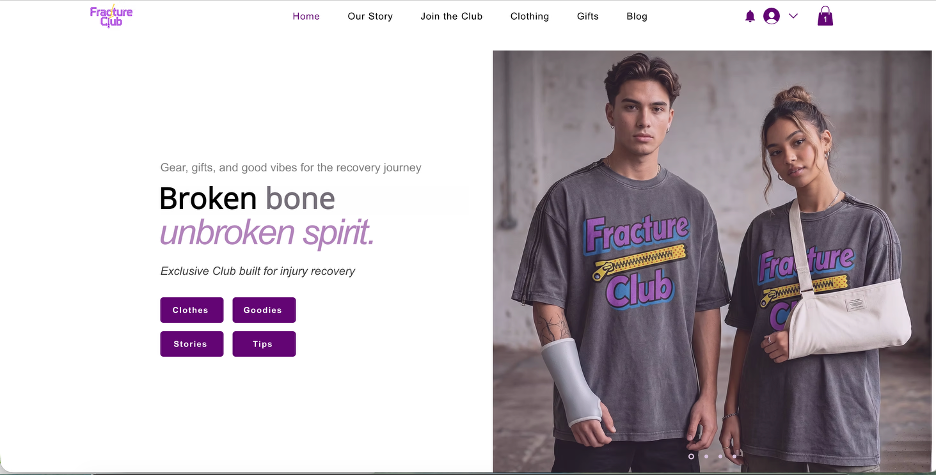
When someone you care about is recovering from a fracture, orthopedic surgery, or any injury that involves a cast or brace, getting dressed becomes one of the hardest parts of the day. Fracture-club’s adaptive recovery pants are built specifically for that moment: side magnetic zippers open wide enough to dress over a cast or brace without removing any medical device. The fabric is soft, breathable, and machine-washable, which makes it appropriate for both hospital and home use. The easy-on recovery sweatshirt covers upper-limb injuries with the same open-side design.
[
](fracture-club.com)
Both items ship directly to the patient or to you, so you can include a handwritten note with care instructions before delivering. Order in the patient’s size, add a personal message, and you have a gift that does something a get-well card cannot. Visit Fracture-club to browse the full recovery collection and find the right fit.
Sources
Recommended
Comments