
Connecting Caregivers to Injury Recovery Communities
- T. Armstrong

- 10 minutes ago
- 10 min read
Three places to start today: the Caregiver Action Network online community, your survivor’s hospital or rehab peer-support coordinator, and your state’s caregiver support-group listing. Register for the CAN forum in minutes. Call the UAMS Brain Injury Program or your local rehab center and ask specifically for the “caregiver peer coordinator.” Search your state health and human services site for a support-group finder.
You don’t need all three. You need one conversation this week.
National forum: Join Caregiver Action Network’s community for 24/7 peer access
Hospital program: Call your rehab center’s caregiver line, or try Shepherd Center’s peer support program
State listing: Search “[state name] caregiver support groups” or check Family Caregiver Alliance
Key Takeaways
Connecting with the right caregiver community starts with one specific call or registration this week, not an open-ended search across dozens of options.
Point | Details |
Start with three sources | Try Caregiver Action Network, your rehab center’s peer coordinator, and your state’s support-group listing. |
Match format to your schedule | Choose peer-led groups, clinician workshops, or email lists based on time and comfort level. |
Screen for safety first | Check facilitator credentials, confidentiality policy, and registration clarity before committing. |
It’s fine to just listen | Observing without speaking for the first few sessions is normal and still valuable. |
Ease the physical load | Fracture-club’s adaptive clothing reduces dressing friction, freeing energy for community and recovery work. |
Table of Contents
Trusted Places to Find Caregiver Communities
Finding a caregiver community shouldn’t feel like another research project piled onto an already exhausting week. It doesn’t have to be. A handful of organizations have already done the vetting work for you, and knowing which one to call first saves you hours of scrolling through forums that may or may not still be active.
Caregiver Action Network (CAN) is a strong starting point because it combines several access points in one place: expert-led guidance, an app with 24/7 resource access, live virtual chats, a peer community on Facebook, and “certified listeners” matched by lived experience rather than clinical training. If you want something available at 2 a.m. when you can’t sleep, this is where to look.
[

Family Caregiver Alliance (FCA) functions more like a directory than a single community. Its support group listings span email lists, live online meetings, and continuous social forums, and most require advance registration before you get the meeting link.
For hospital-based support, call ahead rather than searching cold:
Shepherd Center runs peer support groups specifically for brain and spinal cord injury families. Ask for the peer support coordinator by title.
UAMS Brain Injury Program maintains a caregiver resource directory connecting families to both clinical and peer resources.
State health and human services sites often run their own finders. Texas, for example, hosts a statewide support group locator built specifically around TBI and acquired brain injury.
Virtual groups tend to have looser scheduling; in-person groups usually meet weekly or monthly at a fixed location. Either way, expect to register before you get access.
Types of Caregiver Communities and What They Offer
Not every group looks the same, and picking the wrong format is a common reason caregivers try one meeting and never come back. Peer-led groups are run by other caregivers who’ve lived through similar situations. Clinician-led workshops bring in a social worker or psychologist to guide structured sessions. One-to-one peer mentoring pairs you with a single caregiver further along in their journey. Email lists and social forums offer lower-commitment, asynchronous connection for caregivers who can’t commit to a set meeting time.
Facilitator type shapes what you can expect. A trained volunteer mentor or peer moderator focuses on shared experience and emotional support, not medical advice. A clinician or social worker can address clinical questions but may keep firmer boundaries around personal disclosure.
Research on peer mentorship suggests small groups of roughly 8 to 12 participants tend to produce deeper engagement than large, open forums, since members get more airtime and closer matching to similar diagnoses or caregiving stages.
Peer-led groups: informal, experience-based, often the most emotionally candid
Clinician-led workshops: structured, topic-driven, useful early in recovery
One-to-one mentoring: flexible scheduling, deeply personal
Email lists and forums: low-commitment, good for night owls and new parents of survivors
Pro Tip: Before joining, ask whether the group requires manual approval to join. Communities that screen new members tend to stay safer and more honest, since it filters out spam accounts and sales pitches.
How to Evaluate a Caregiver Support Group
Not every group that shows up in a search is the right fit, and some aren’t safe at all. Before you commit your evening, run through a short mental checklist.
Focus. Is this group TBI-specific, or general caregiving? A group built around dementia caregiving won’t address the same challenges as one built around traumatic brain injury recovery.
Facilitator credentials. Is the moderator a clinician, a trained volunteer, or simply the first person who created a Facebook group?
Format and schedule. Does the meeting time work around your caregiving duties, and is it virtual or in-person?
Privacy rules. Does the group state a confidentiality policy, or is it a public forum anyone can screenshot?
Cost and accessibility. Is it free? Does it offer childcare, or accommodate limited tech access?
When you contact a program, ask directly: How do I register? Is there a waitlist? What topics come up most in sessions? Groups that can’t answer clearly, or that pivot into pitching a paid product, are worth skipping.
Red flag: unmoderated public groups that tolerate arguing or harassment
Red flag: no clear contact person or registration process
Red flag: pressure to buy something before you can “really” join
Specialty groups (TBI-specific, pediatric, adolescent) tend to offer more relevant conversation than broad caregiver groups, but broad groups often meet more frequently. Weigh depth against availability.
How to Join a Group and Make Your First Meeting Count
Joining is simpler than it feels from the outside. Follow these steps and you’ll likely be in a meeting within a week.
Find the listing through CAN, FCA, or your state’s caregiver resource page.
Register or email the coordinator directly, even if a session shows as full. According to insiders, waitlists move faster than people assume.
Confirm the time zone and get the video link in writing before the day of the meeting.
Test your video and audio ahead of time. A dropped connection five minutes in is a common reason first meetings feel discouraging.
Show up with one or two things you’d like to share or ask, even if you never use them.
Set your display name to something recognizable to the group, and mute yourself when you’re not speaking.
It’s completely fine to listen for the first few sessions without saying a word. Community moderators consistently note that caregivers gain real value just from hearing they aren’t alone, long before they’re ready to speak up themselves.
Starting Your Own Circle or Becoming a Peer Mentor
If nothing local fits, build the group you needed. Start small: define your focus (TBI caregivers specifically, or trauma recovery broadly), pick one format, and recruit 6 to 12 founding members through your hospital’s discharge coordinator or a local rehab center’s bulletin board.
Set basic ground rules upfront: confidentiality, no medical advice, and a fixed weekly or biweekly time. Peer mentoring works the same way. Many national organizations offer light training before matching you with a newer caregiver, with clear boundaries around what mentors do and don’t provide.
Partnering with a rehab center or nonprofit gives your group instant credibility and a built-in referral pipeline, something community-driven outreach tends to accomplish faster than starting from scratch alone.
What the Research Says About Peer Support
Caregivers of brain injury and trauma survivors frequently become de facto medical advocates, coordinating appointments, medications, and insurance while managing their own grief. Experts at the Schurig Center point out that this role shift often leads to isolation, and that caregiver wellbeing directly affects a survivor’s long-term recovery trajectory.
Peer mentorship models built around small groups appear to reduce burnout more effectively than generic support resources, largely because members are matched with people who’ve navigated similar conditions rather than general audiences. The value isn’t expert lectures. It’s another caregiver saying “yes, that happened to me too” and meaning it.
Shared lived experience often produces faster emotional validation than clinical advice alone
Small groups allow more direct matching between caregivers facing similar injuries
Community involvement is linked to steadier, more sustained caregiving over months and years, not just an initial burst of support
What to Expect Once You’re in a Group
Walking into your first meeting, virtual or in-person, comes with a few predictable elements. Confidentiality is usually stated upfront, sometimes as a verbal agreement, sometimes in writing during registration. Group size varies, but many peer-led circles stay intentionally small, often under 15 people, so everyone gets a chance to talk if they want to.
Facilitators typically introduce themselves and their background in the first few minutes. Some are licensed clinicians or social workers; others are trained volunteers or fellow caregivers who’ve simply been doing this longer. Ask about this directly if it isn’t mentioned. It shapes how clinical (or how informal) the conversation will be.
Session topics rotate but tend to circle familiar ground: managing caregiver guilt, navigating insurance and disability paperwork, handling behavioral changes in a survivor, and simply venting about exhaustion without judgment. Some groups build in structured check-ins where each person gets a few minutes uninterrupted. Others run more like an open conversation.
Mayo Clinic Connect, for example, hosts virtual caregiver support meetings that explicitly reserve the space for caregivers only, plus an ongoing online forum for conversation between live sessions. That combination, a live meeting plus an asynchronous space, is becoming more common because it accommodates caregivers who can’t always make a fixed time slot.
Don’t expect medical advice from peer facilitators. That boundary exists for good reason: peer support works because it’s rooted in shared experience, not clinical authority.
Cost and How Often Groups Meet
Most caregiver support groups are free. That’s true across nearly every organization mentioned so far, from CAN’s community programs to state-run listings. What isn’t always free is your time, since nearly all of them require advance registration before you receive a meeting link, address, or dial-in number.
Frequency varies widely. Some hospital-based groups meet weekly, others monthly. Email lists and social forums operate continuously, so there’s no fixed schedule to miss. State program listings are typically updated periodically, meaning a group’s meeting time or format can shift, so confirm details before you plan around a session.
A practical note: sessions listed as “full” aren’t necessarily closed. Registration systems for popular groups often carry waitlists, and coordinators frequently accommodate a few extra attendees or offer the next available slot faster than the listing suggests. Call or email rather than assuming the door is shut.
If cost ever does come up, such as for a specialized workshop or a paid mentoring program, that’s worth treating as a flag to ask more questions, not necessarily a dealbreaker. Just confirm what the fee covers and whether free alternatives exist through the same organization.
Finding Culturally and Language-Specific Support
Caregiving looks different depending on your family structure, language, and cultural expectations around illness and disability. A support group that doesn’t reflect that context can feel hollow even when the facilitator means well.
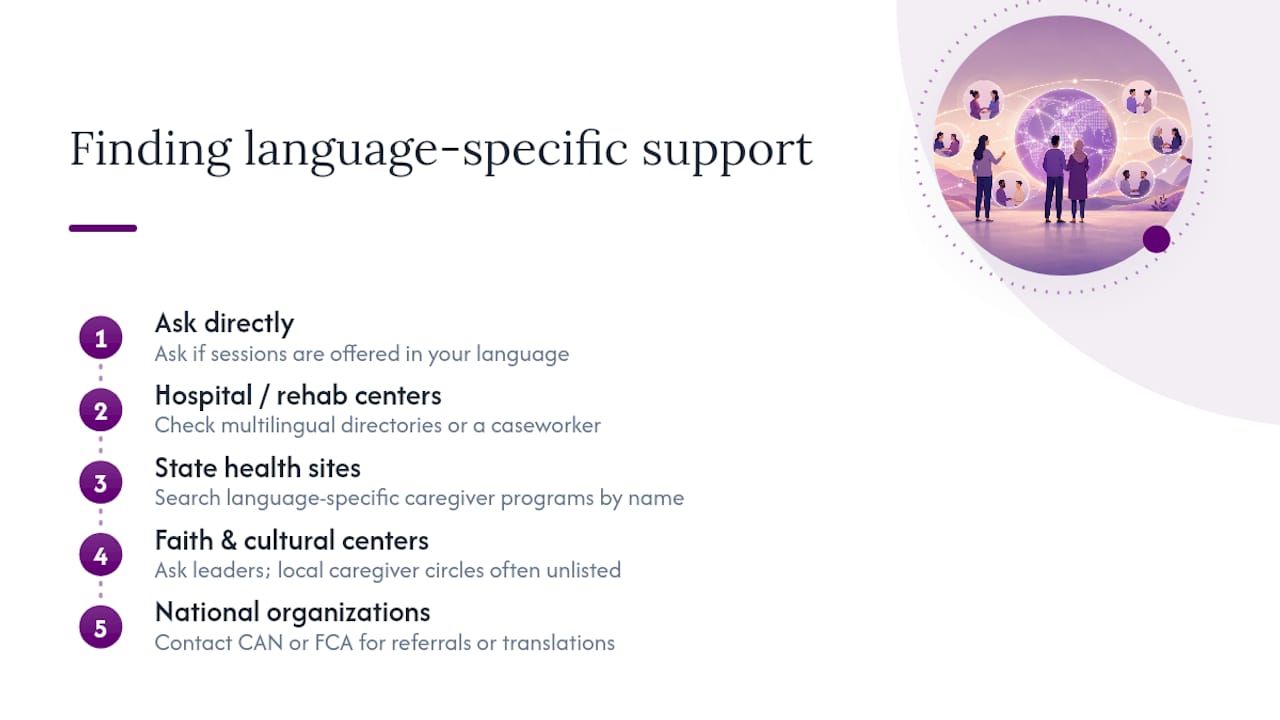
When searching for a group, ask directly whether sessions are offered in your primary language, or whether interpretation is available. Many hospital systems, including larger rehab centers, maintain multilingual resource directories or can connect you with a case worker who speaks your language. State health and human services sites sometimes list language-specific caregiver programs separately from general ones, so it’s worth checking those pages by name rather than assuming inclusion.
Faith-based and cultural community centers frequently run informal caregiver circles that never show up in a national database but carry deep trust within a specific community. Asking a religious leader, cultural association, or even a local library branch about caregiver resources can surface options that a generic search never will.
If you can’t find a language-specific group locally, ask a national organization like CAN or FCA whether they can refer you to one, or whether they’re willing to help translate materials for a group you start yourself.
A Caregiver’s View From Inside the Community
Joining a group after my sister’s injury felt like admitting I couldn’t handle it alone. It turned out to be the opposite. Other caregivers taught me how to talk to insurance adjusters, how to spot burnout in myself before it became a crisis, and that grieving the person she used to be didn’t mean giving up on who she was becoming.
Practical Support Between Meetings: Fracture-club
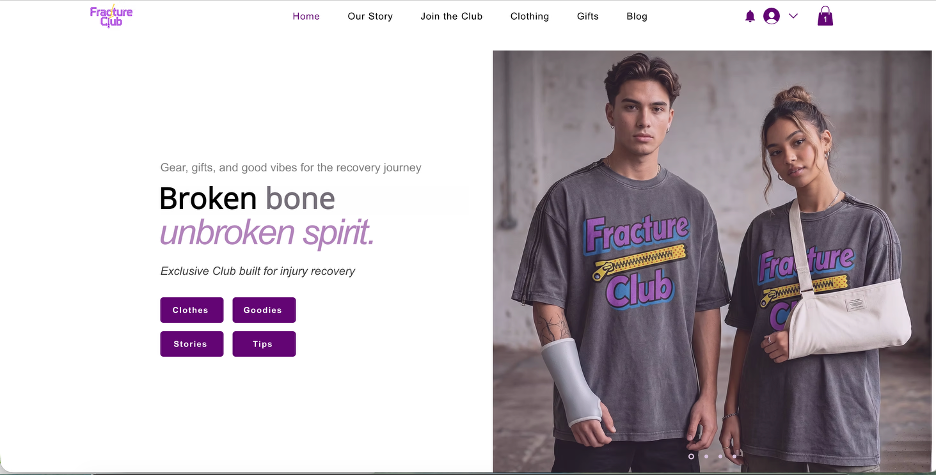
Community carries you emotionally, but the daily grind of dressing changes, cast care, and helping someone move safely still falls on you between meetings. That’s where a tool like Fracture-club fits in, not as a replacement for peer support, but as a practical aid that makes hands-on caregiving less physically taxing.
[
](fracture-club.com)
Fracture-club designs adaptive clothing with magnetic and zippered closures specifically so dressing someone with a cast or brace doesn’t turn into a wrestling match every morning. The adaptive recovery pants open at the side, cutting down on painful maneuvering for both of you. If your loved one has an upper-limb injury, the easy-on/off sweatshirt solves a similar problem for arms and shoulders that can’t twist into a regular pullover.
None of this replaces the emotional support a caregiver community provides. It just makes one part of your day physically easier, so you have more energy left for the calls, the group meetings, and the person you’re caring for. If you’re outfitting a caregiving routine or looking into bulk orders for a support group, Fracture-club’s inquiry page is a fast way to start that conversation.
Where to Go Next: Trusted Organizations and Programs
Caregiver Action Network: community support, app-based 24/7 access, and certified listeners matched by lived experience
Family Caregiver Alliance: support group directory spanning email lists, live meetings, and state referrals
CarePeer: a moderated peer community matching caregivers into small recurring circles, run by caregivers rather than corporate staff
Shepherd Center: peer support groups focused on brain and spinal cord injury caregiving
UAMS Brain Injury Program: hospital-affiliated caregiver resource directory
State listings: search your state health and human services site, or try tools like Texas’s support group finder
Mayo Clinic Connect: hosts recurring virtual caregiver-only meetings with an ongoing discussion forum
Most require advance registration, and some carry waitlists. Reach out anyway. Coordinators can usually tell you the real wait time, which is often shorter than the listing suggests.
This article is general information, not a substitute for advice from a qualified doctor. Consult a qualified healthcare professional about your own circumstances before acting on anything here.
Sources
Recommended
Comments