
600–2,000 IU: When Vitamin D Raises Bone Strength After a Fracture


Vitamin D lets your body absorb the calcium it needs to keep bones dense and strong, and without enough of it, bones soften and fracture risk climbs. The NIH’s Office of Dietary Supplements sets age-specific vitamin D intake recommendations, which vary by life stage. If you have risk factors like limited sun exposure, darker skin, malabsorption, or a prior fracture, ask your doctor about testing before you start high-dose supplements on your own.
TL;DR:
Vitamin D intake recommendations vary by age, and testing is recommended only for those with risk factors like malabsorption or prior fractures.
Sun exposure is the primary natural source but is limited by season, skin pigmentation, and sunscreen use, making supplementation necessary for many.
Combining vitamin D with calcium improves bone density and reduces fracture risk in older adults, but supplementation alone offers limited benefits for healthy, active adults.
Blood levels below 12 ng/mL indicate deficiency, and high-dose supplementation without medical supervision can cause toxicity and harm.
Supporting bone health also requires adequate calcium intake, physical activity, and fall prevention exercises, beyond just vitamin D supplementation.
Table of Contents
How Vitamin D Supports Bone Health
Your skin makes vitamin D from sunlight, but that raw form is inactive. The liver converts it to 25(OH)D, the form doctors measure in blood tests, and the kidneys then activate it into 1,25(OH)2D, the hormone that actually does the work in your gut and bones. That active form tells your intestines to absorb dietary calcium instead of letting it pass through unused.
When vitamin D runs low, your body doesn’t just accept weaker bones quietly. It pulls calcium out of your skeleton to keep blood calcium stable, a survival mechanism that leaves bones progressively more porous. Left uncorrected, this drives rickets in children and osteomalacia in adults, and over years it contributes to osteoporosis.
Vitamin D also does something a lot of people miss entirely: it supports the muscles that keep you upright.
Adequate vitamin D status is linked to better muscle strength and balance.
Weaker muscles mean more falls, and falls are what actually break bones in older adults.
Mayo Clinic notes this muscle support works alongside, not instead of, its calcium-absorption role.
What Are the Recommended Vitamin D Levels for Bone Health?
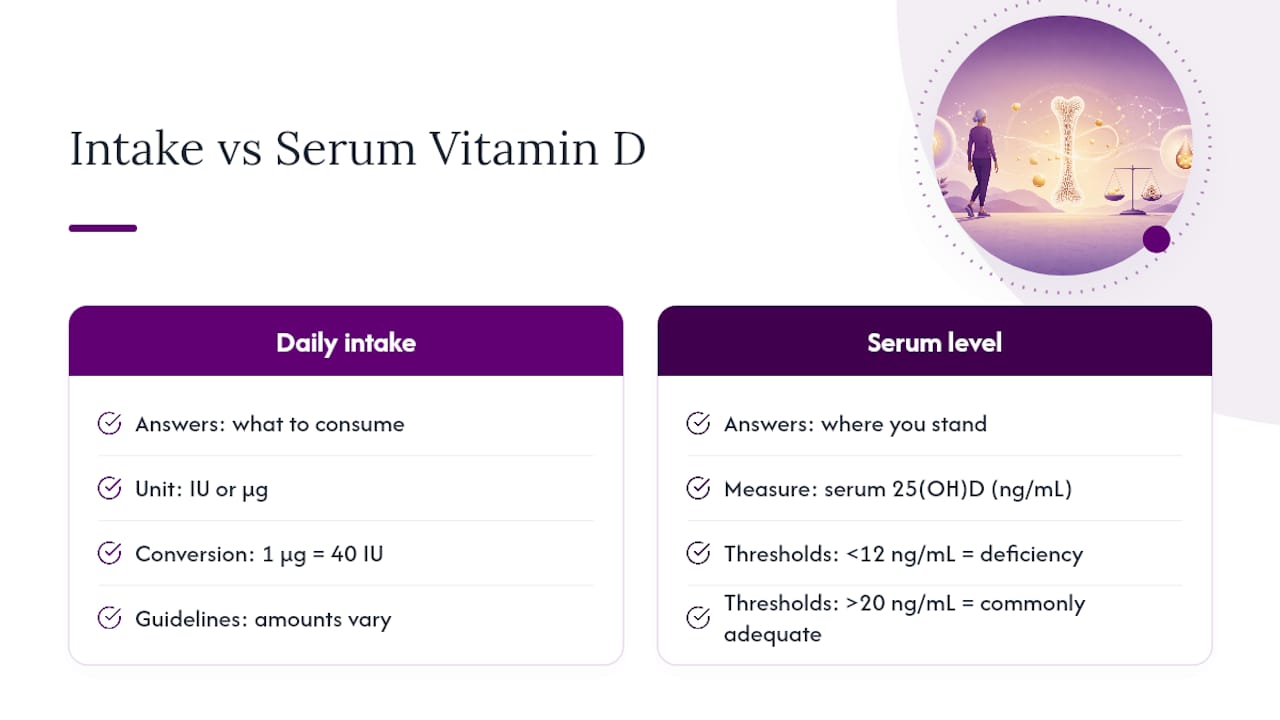
Guidelines separate how much you should take in daily from what your blood level should read. Both matter, but they answer different questions: intake targets tell you what to consume; blood levels tell you where you actually stand.
One microgram equals 40 IU, per the ODS/NIH reference. Serum 25(OH)D levels below 12 ng/mL generally signal deficiency, while adequacy is commonly placed above 20 ng/mL, though labs vary in assay methods and guideline bodies don’t fully agree on the exact cutoff. Clinicians sometimes target higher levels for patients with malabsorption disorders or established osteoporosis, but that decision belongs in a conversation with your doctor, not a blanket rule for everyone.
Where Does Vitamin D Actually Come From?
Sunlight is the most efficient natural source, but it’s also the least reliable one. Your skin’s production drops sharply in winter months, at higher latitudes, with darker skin pigmentation, with age, and the moment you apply sunscreen, which blocks the UVB rays that trigger synthesis.
Food closes some of that gap, though not as much as most people assume.
Fatty fish like salmon, trout, mackerel, and tuna are among the few foods naturally rich in vitamin D.
Fortified products, including milk, some yogurts, cereals, and orange juice, contribute meaningfully but rarely cover the full RDA alone.
Egg yolks and mushrooms exposed to UV light offer smaller amounts.
Supplements fill the remaining gap for most adults, and vitamin D3 (cholecalciferol) tends to raise blood levels more efficiently than D2 (ergocalciferol) in head-to-head trials, which is why it’s the form most over-the-counter products now use. Typical maintenance doses run from 600 to 2,000 IU daily, though your actual need depends on your baseline level.
Pro Tip: Take your vitamin D supplement with a meal that contains some fat. It’s fat-soluble, so absorption improves noticeably compared to taking it on an empty stomach.

Does Vitamin D Improve Bone Density?
Here’s where the evidence gets more nuanced than most headlines suggest. Vitamin D alone, without adequate calcium, rarely moves the needle much on bone density. The combination is what matters.
Systematic reviews and randomized trials show vitamin D paired with calcium produces modest bone mineral density gains, and in older or institutionalized adults, that combination can meaningfully reduce fracture and fall rates. That’s a genuinely useful finding for nursing home residents and homebound elderly patients, who tend to have the lowest baseline vitamin D status to begin with.
The catch: in healthy, community-dwelling adults who already get reasonable sun exposure and eat a typical diet, fracture benefit from supplementation is inconsistent across trials. Some studies find nothing measurable.
Why the gap? A few reasons stand out:
Baseline deficiency predicts the size of the benefit. People who start low see more improvement; people who start adequate see little to none.
High-dose trials have sometimes produced null results or, in a few cases, unexpected harms, reinforcing that more isn’t automatically better.
Adherence is a persistent problem in long trials. A supplement that isn’t taken consistently can’t show a consistent effect, and separating vitamin D’s contribution from calcium’s is genuinely difficult in combined trials.
The honest summary: vitamin D is necessary for bone health, but supplementation is not a guaranteed fix if your baseline levels are already fine.
When Should You Test and Treat Vitamin D Levels?
Testing everyone for vitamin D deficiency sounds sensible until you look at what the guidelines actually recommend. They don’t support it.
Skip universal screening. Clinical guidance advises against testing everyone; it’s reserved for people with specific risk factors.
Get tested if you have risk factors. That includes malabsorption conditions, chronic kidney disease, certain medications, obesity, or a history of low bone density or fracture.
Follow a supervised repletion plan if you’re deficient. Clinicians often prescribe a higher dose for several weeks, then step down to a standard maintenance dose aligned with the RDAs.
Recheck levels after repletion, rather than assuming the initial dose fixed things permanently.
Chronic high-dose vitamin D intake carries real risk. Excess vitamin D can cause toxicity, including elevated blood calcium, and it can interact with certain heart and blood pressure medications.
Pro Tip: Never start a high-dose vitamin D regimen on your own based on an online recommendation. Confirm your actual blood level first. Our guide to reading bone health lab results walks through what those numbers mean.
What Else Supports Bone Health Alongside Vitamin D?
Vitamin D works as part of a system, not a solo act. Calcium is the raw material your bones are built from, and no amount of vitamin D compensates for consistently low calcium intake. Dairy, fortified plant milks, leafy greens, and canned fish with bones (like sardines) all help close that gap.
Movement matters just as much as anything you swallow.
Weight-bearing activities like walking, dancing, or stair climbing stimulate bone formation directly.
Resistance training builds the muscle mass that protects joints and reduces fall risk.
Balance exercises, like tai chi or simple standing drills, cut fall rates in older adults, which our fall prevention guide covers in more depth.
Smoking, heavy alcohol use, and being significantly underweight all independently weaken bone, regardless of your vitamin D status.
Fracture Club’s Perspective on Bone-Health Education
We built Fracture Club because bone health education shouldn’t stop at the discharge papers. Following a vitamin D and calcium plan matters, but so does staying mobile and independent while you heal, which is why our recovery clothing exists alongside our bone health supplements checklist. Getting the science right and getting dressed without help are both part of recovery.
— Fracture
Recovery Clothing That Actually Works Around a Cast
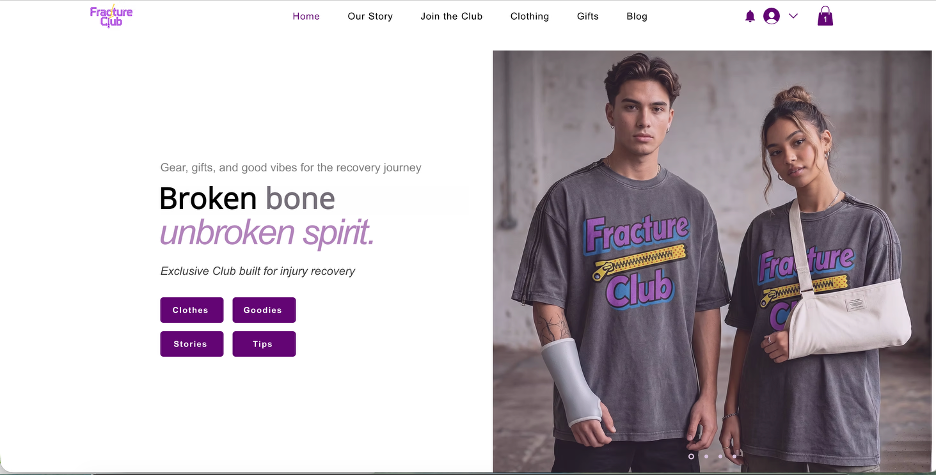
Following a solid vitamin D and calcium plan is one half of healing. The other half is getting through your day without wrestling a pullover shirt over a cast or fighting zippers with a fractured wrist. That’s the gap Fracture-club fills for people mid-recovery.
[
](fracture-club.com)
Our unisex easy-on/off adaptive recovery pants use side magnetic zippers instead of a waistband you have to step into, which matters enormously when a leg brace makes ordinary dressing painful or impossible. If your injury is higher up, the easy-on/off sweatshirt is built the same way for shoulder and arm fractures. A portion of every purchase goes to the Bone Health & Osteoporosis Foundation, so buying something that makes your recovery easier also supports the research behind the guidance in this article. Browse the full Fracture Club collection or reach out through our inquiry page if you need help choosing the right fit for a specific cast or brace.
Where to Read More on Vitamin D and Bone Health
For deeper reading, the ODS/NIH fact sheet covers RDAs in full detail, NIAMS offers patient-friendly food lists, and the NCBI review breaks down the trial evidence behind supplementation.
This article is general information, not a substitute for advice from a qualified doctor. Consult a qualified healthcare professional about your own circumstances before acting on anything here.
Sources
Recommended
Comments