
Stress Fracture Explained: Causes, Symptoms, and Recovery

A stress fracture is a small crack in a bone caused by repetitive mechanical stress that exceeds the bone’s natural repair capacity. Unlike a traumatic fracture from a single impact, this injury builds gradually, often catching runners, military recruits, and active individuals off guard. Understanding what a stress fracture is, how it develops, and how to treat it properly can mean the difference between a six-week recovery and a six-month setback. The good news: with the right information and a pain-guided approach, most people heal fully and return to the activities they love.
What is a stress fracture and how does it develop?
A stress fracture develops along a continuum when repetitive submaximal loading outpaces the bone’s ability to remodel and repair itself. Think of it like bending a paperclip back and forth. No single movement breaks it, but the accumulated stress eventually causes failure. Bone is living tissue that constantly breaks down and rebuilds, and when breakdown outpaces repair, microcracks form and can progress into a true fracture.
Stress injuries are graded 1 to 4 in clinical practice. Grade 1 represents early bone stress with no visible crack, while Grade 4 is a complete fracture line. Ignoring early-grade symptoms is one of the most common mistakes people make, and it often transforms a manageable injury into one requiring surgery or prolonged immobilization.
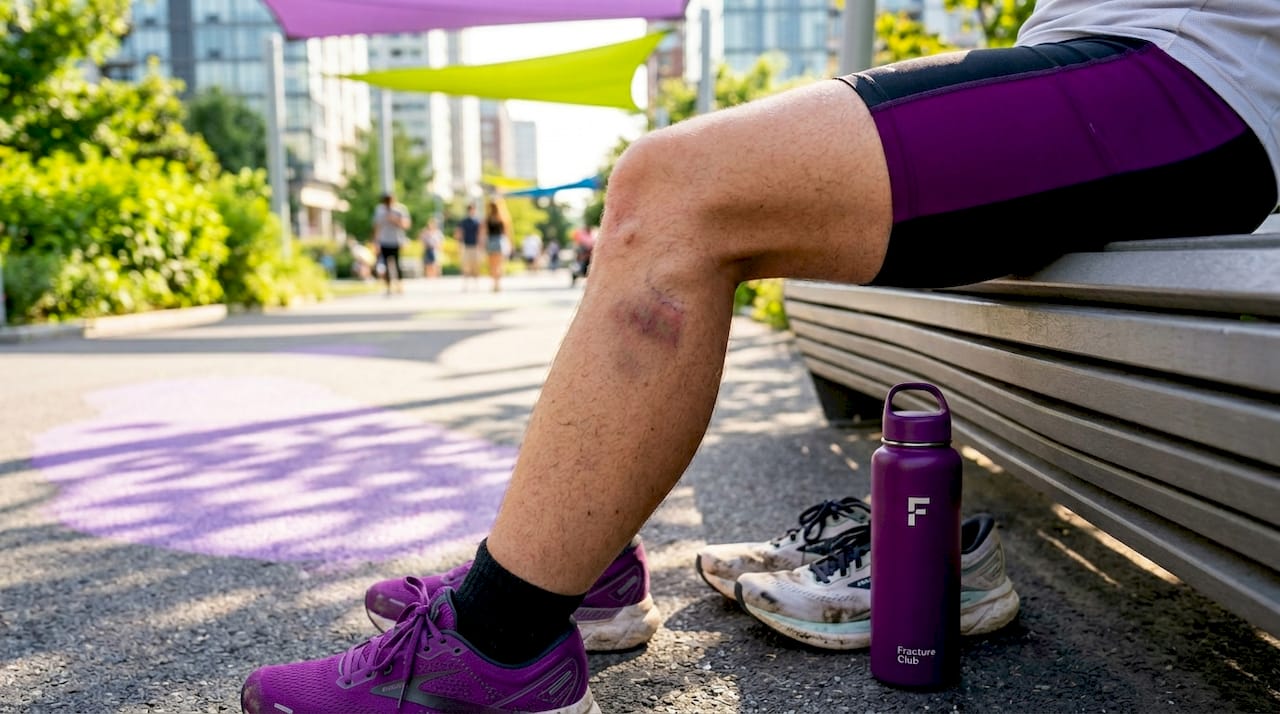
The tibia, metatarsals, and navicular are the most frequently affected bones, particularly in runners and field sport athletes. Early diagnosis is the single most important factor in preventing a Grade 1 or 2 injury from becoming a Grade 3 or 4.
How do stress fractures happen? Key causes and risk factors
Stress fractures happen when bone remodeling falls behind mechanical demand. Bone needs roughly 48 to 72 hours between high-impact sessions to remodel effectively. When training volume spikes too quickly, that recovery window disappears and microcracks accumulate faster than the body can address them.
Several factors raise your personal risk significantly:
Rapid training increases. Jumping training volume by more than 10 percent per week is the most cited trigger. The bone simply cannot adapt fast enough.
Low bone density. Conditions like osteoporosis or osteopenia reduce the bone’s structural reserve, making fractures more likely under normal loads.
Nutritional deficits. Inadequate calcium, vitamin D, and overall caloric intake compromise bone remodeling. Post-fracture nutrition directly affects how quickly bone repairs itself.
Biomechanical issues. High arches, flat feet, or leg length discrepancies create uneven load distribution across bones.
Worn footwear. Replacing athletic shoes every 300 to 500 miles maintains proper shock absorption and reduces localized bone stress.
Hard training surfaces. Concrete and asphalt transmit more impact force than grass or rubberized tracks.
Female athletes carry a disproportionately high risk. Higher rates of tibial, metatarsal, and tarsal stress fractures are linked to the Female Athlete Triad, a syndrome combining low energy availability, menstrual disruption, and reduced bone density. This is not a minor statistical footnote. It means female athletes need proactive monitoring of both training load and hormonal health, not just mileage logs.
Pro Tip: If you are a female athlete experiencing irregular periods alongside bone pain, speak with a sports medicine physician about energy availability screening. This combination is a red flag for elevated fracture risk.
What are the symptoms of a stress fracture?
Pain from a stress fracture persists during and after activity at a precise, localized point on the bone. This is the defining clinical feature that separates it from muscle soreness or shin splints, which tend to produce diffuse, generalized discomfort that fades quickly with rest.
The typical symptom progression looks like this:
Early stage. Mild aching during the latter part of a workout that disappears within minutes of stopping.
Mid stage. Pain begins earlier in the session, lingers for hours afterward, and may appear during normal walking.
Late stage. Pain is present at rest, can wake you at night, and is reproducible by pressing firmly on a specific spot on the bone.
Swelling and localized tenderness over the bone are common physical signs. The single-leg hop test is a useful initial indicator: if hopping on the affected leg reproduces sharp, localized bone pain, a stress fracture is a strong clinical possibility. This test does not replace imaging, but it gives you and your clinician a meaningful early signal.
Distinguishing a stress fracture from shin splints matters because the treatment approach differs. Shin splints produce pain along the inner edge of the tibia over a broad area, typically from muscle and connective tissue stress. Stress fracture pain is pinpoint, often worsens with direct palpation of the bone, and does not resolve with a few days of rest the way shin splints often do.
Pro Tip: Mark the exact spot where your pain is most intense with a pen before your appointment. Clinicians call this the “point of maximum tenderness,” and it helps guide imaging decisions quickly.
How are stress fractures diagnosed?
Standard X-rays miss most early-stage stress fractures because the initial microcracks are too small to appear on film. MRI is the gold standard for detecting stress fractures early, showing bone marrow edema and crack lines that X-rays cannot capture. This distinction matters because waiting for an X-ray to confirm a fracture often means waiting until the injury has progressed significantly.
Imaging method | Sensitivity for early fractures | Best used when |
X-ray | Low (misses Grade 1 and 2) | Ruling out complete fractures or other bone pathology |
MRI | High (detects all grades) | Suspected early stress fracture, negative X-ray with ongoing pain |
Bone scan | Moderate to high | When MRI is unavailable; less specific than MRI |
CT scan | Moderate | Assessing fracture geometry before surgical planning |
Clinical history and physical examination remain central to diagnosis. A clinician will ask about recent training changes, footwear, menstrual history in female athletes, and dietary habits. The combination of a clear pain pattern, point tenderness, and a relevant training history often justifies MRI even before imaging confirms anything. Risk stratification, meaning whether the fracture is in a high-risk or low-risk bone, then guides how urgently you need advanced imaging and specialist referral.
What are the treatment options and recovery timelines?
Treatment for a stress fracture depends on its location, grade, and whether the bone has an adequate blood supply. Here is how management typically progresses:
Immediate offloading. For most low-risk fractures, conservative treatment means non-weight bearing rest, a walking boot, or crutches. The goal is to remove the mechanical load that is preventing repair.
Pain-guided activity modification. Return to activity is governed by pain tolerance, not a fixed calendar. Movements that place excessive load on the healing bone, such as high-impact jumping or rising onto the ball of the foot, are avoided until the bone is pain-free under normal daily activity.
Cross-training. Swimming, cycling, and pool running maintain cardiovascular fitness without loading the injured bone. This is not optional downtime. It is an active part of recovery.
Nutrition support. Adequate calcium, vitamin D, and total caloric intake are non-negotiable during healing. The role of magnesium in bone repair is also worth discussing with your care team, as deficiency is common and often overlooked.
Surgical intervention. Certain bones carry a high-risk designation because of limited blood supply. The base of the fifth metatarsal is a prime example. Fractures here risk non-union, meaning the bone fails to heal, and often require surgical fixation.
Stress fracture recovery time follows a predictable but variable arc. Most low-risk fractures heal in 8 to 12 weeks, with full return to high-impact training taking 8 to 16 weeks depending on bone location and individual healing rate. High-risk fractures or those diagnosed late can extend well beyond that window.
Pro Tip: Keep a daily pain log during recovery. Rate your pain from 0 to 10 during activity and at rest. This gives your clinician objective data to guide your return-to-sport timeline rather than relying on memory.
How can stress fractures be prevented?
Prevention centers on giving bone enough time and resources to keep up with the demands you place on it. These strategies are backed by clinical evidence and are practical for most active individuals:
Follow the 10 percent rule. Increase weekly training volume by no more than 10 percent at a time. This applies to mileage, weight, and session frequency.
Prioritize calcium and vitamin D. Adequate calcium and vitamin D are foundational to bone remodeling. Adults generally need 1,000 to 1,200 mg of calcium and 600 to 2,000 IU of vitamin D daily, though individual needs vary.
Replace footwear on schedule. Worn-out shoes lose shock absorption long before they look worn out. Track your mileage and replace training shoes every 300 to 500 miles.
Get a biomechanical assessment. A sports physiotherapist or podiatrist can identify gait abnormalities, arch issues, or muscle imbalances that create uneven bone loading.
Build in rest days. Bone remodeling requires recovery time. Two consecutive high-impact training days without a rest day in between is a common setup for overuse injury.
Monitor energy availability. For female athletes especially, undereating relative to training load is a direct pathway to reduced bone density and elevated fracture risk.
Prevention strategy | Primary benefit | Who benefits most |
10 percent training rule | Limits microcrack accumulation | All active individuals |
Calcium and vitamin D intake | Supports bone remodeling | Everyone, especially women over 30 |
Footwear replacement | Reduces impact transmission | Runners and court sport athletes |
Biomechanical assessment | Corrects uneven bone loading | Those with foot structure issues |
Rest and cross-training | Allows bone repair between sessions | High-volume athletes |
Key takeaways
Stress fractures heal fully with the right management, but early recognition and a pain-guided recovery plan are the two factors that determine whether you are back in six weeks or six months.
Point | Details |
Definition and mechanism | A stress fracture is a bone crack caused by repetitive loading that outpaces the bone’s repair capacity. |
High-risk bones need more care | Bones like the fifth metatarsal have limited blood supply and may require surgery if not managed carefully. |
MRI over X-ray for early detection | Standard X-rays miss early-stage fractures; MRI detects all grades and should be requested when pain persists. |
Recovery is pain-guided, not calendar-based | Return to activity depends on pain-free function, not a fixed number of weeks. |
Prevention is trainable | Gradual load increases, proper nutrition, and footwear replacement reduce fracture risk significantly. |
What I have learned from watching people navigate stress fractures
The most consistent pattern I have seen is this: people wait too long. They rationalize the pain as normal training soreness, push through it for weeks, and arrive at a clinic with a Grade 3 or 4 injury that could have been a Grade 1 if they had acted at the first sign of localized bone pain. The body is not subtle about stress fractures. It gives you clear, location-specific signals. The problem is that most people have been trained to ignore discomfort, especially athletes.
The second thing I have noticed is how often nutrition gets overlooked in the recovery conversation. Clinicians focus on offloading and imaging, which is correct, but the bone cannot rebuild without raw materials. Calcium, vitamin D, and total caloric intake are not supplementary considerations. They are structural requirements. I have seen recoveries stall not because of inadequate rest but because the person was under-eating during a period when their body needed more fuel, not less.
The third pattern is the emotional side of recovery, which rarely gets addressed directly. Being sidelined from the activity that defines your routine is genuinely hard. It affects mood, identity, and motivation. Acknowledging that difficulty is not weakness. It is honest. The people who recover best are the ones who find ways to stay engaged with their fitness through cross-training, who treat nutrition as an active intervention, and who follow a pain-guided plan with patience rather than forcing a timeline.
— Fracture
Recovery wear that works as hard as you do
Healing from a stress fracture often means navigating boots, braces, and limited mobility while still trying to feel like yourself. Fracture-club designs recovery wear specifically for this moment. The adaptive recovery pants feature magnetic side zippers that make dressing possible even when your range of motion is restricted by a walking boot or brace. No struggling. No frustration. Just practical clothing built for real recovery.
Fracture-club also offers personalized support through its inquiry services for anyone who needs guidance on the right products for their specific injury. A portion of every purchase benefits the Bone Health & Osteoporosis Foundation, so your recovery supports bone health research at the same time. Browse the full range at Fracture-club and find what makes your healing process a little easier.
FAQ
What exactly is a stress fracture?
A stress fracture is a small crack in a bone caused by repetitive mechanical loading that exceeds the bone’s capacity to repair itself. It differs from a traumatic fracture because it develops gradually through accumulated stress rather than a single impact.
How long does stress fracture recovery take?
Most stress fractures heal in 8 to 12 weeks, with full return to high-impact training taking up to 16 weeks depending on the bone location and injury grade. High-risk fractures in bones with limited blood supply may require longer recovery or surgical intervention.
Can you walk on a stress fracture?
Walking on a stress fracture depends on its location and severity. Low-risk fractures may allow limited weight bearing in a walking boot, but high-risk fractures often require non-weight bearing rest to prevent the crack from progressing to a complete fracture.
How is a stress fracture different from shin splints?
Shin splints produce diffuse pain along the inner tibia that typically eases with rest, while stress fracture pain is pinpoint, localized directly on the bone, and persists after activity stops. MRI and clinical examination confirm the distinction when symptoms are unclear.
What foods support stress fracture healing?
Calcium and vitamin D are the primary nutritional priorities during bone healing, supporting the remodeling process that closes the fracture. Total caloric intake also matters because undereating slows repair, particularly in athletes who continue cross-training during recovery.
Recommended
Comments