
Building a Daily Routine for Injury Recovery That Works


Building a daily routine for injury recovery is the process of creating consistent, purposeful habits that support healing, strengthen your body, and restore function. Rehabilitation science calls this structured approach a clinical rehab protocol, and it is the standard framework used by physical therapists, orthopedic specialists, and sports medicine clinicians worldwide. Without it, passive rest leads to muscle atrophy and joint stiffness that can set your recovery back weeks. The good news is that you do not need a clinical background to build one. You need a clear structure, the right tools, and a realistic plan you can follow every single day.
What are the essential components of an effective injury recovery routine?
An effective injury recovery routine combines physical rehabilitation, mental habits, and lifestyle choices into one repeatable daily structure. Think of it as a three-legged stool: remove any one leg and the whole thing becomes unstable.
Physical components:
SMART goals: Set goals that are specific, measurable, achievable, rewarding, and time-limited. “Walk 10 minutes without pain by week three” beats “get better soon” every time.
Physiotherapy exercises: Include clinician-prescribed mobility drills, gradual strength training, and range-of-motion work. Structured exercises supervised by credentialed professionals reduce the risk of improper form and re-injury.
Balanced rest and activity: Recovery is not a binary choice between doing everything and doing nothing. Alternating active rehab sessions with deliberate rest windows prevents overload.
Lifestyle components:
Nutrition: Protein supports muscle repair; calcium and vitamin D support bone healing. These are not optional extras.
Sleep: Deep sleep is when cellular repair peaks. Protecting 7 to 9 hours per night is a non-negotiable recovery habit.
Adaptive tools: Adaptive clothing like magnetic zipper pants and easy-on/off sweatshirts reduces dressing difficulty and supports consistent daily rehabilitation activities. When getting dressed is painful or exhausting, you are less likely to follow through on your morning routine.
Pro Tip: Write your SMART goals on paper and place them somewhere visible. Seeing your target daily reinforces commitment and reduces the mental friction of deciding whether to do your exercises.
The mental component matters just as much. Daily routines reduce decision fatigue, minimizing poor recovery choices and impulsivity during vulnerable stages of healing. When your schedule is set, you spend less energy deciding what to do and more energy actually doing it.
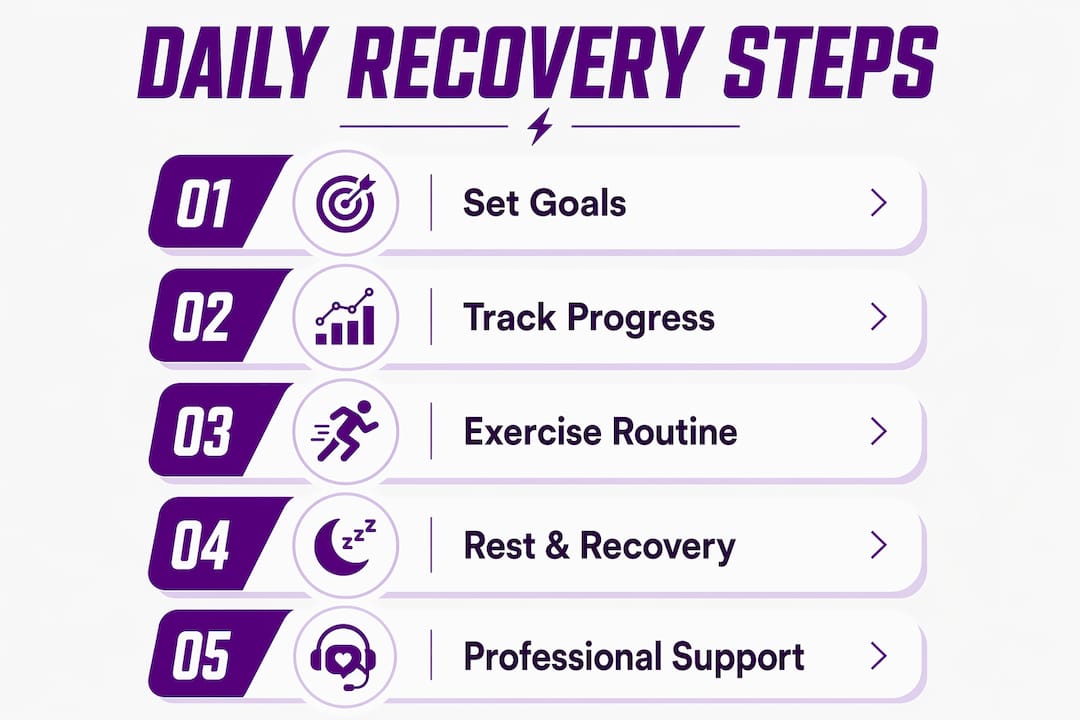
How to structure your daily schedule for progressive rehabilitation
A well-structured recovery day has three distinct phases: morning activation, midday rehabilitation, and evening wind-down. Each phase serves a specific biological and psychological purpose.
Morning: Set the tone. Start with 8 to 16 ounces of water before anything else. Dehydration slows tissue repair. Follow with 5 to 10 minutes of gentle mobility work, targeting the injured area within pain-free ranges. A short mindfulness practice, even just three minutes of focused breathing, lowers cortisol and prepares your nervous system for movement.
Midday: Do the real work. This is when your body temperature and alertness peak, making it the best window for targeted rehab exercises. Complete your prescribed physiotherapy program here. If you work or have caregiving responsibilities, schedule rehab immediately before or after your main midday break so it does not get displaced.
Afternoon: Meaningful activity. Light functional tasks, such as preparing a meal, gentle walking, or a hobby that engages your hands, reinforce the connection between recovery and normal life. This matters psychologically. You are not just a patient. You are a person rebuilding.
Evening: Reflect and prepare. Spend five minutes reviewing how your body felt during the day. Note any swelling, pain changes, or fatigue. Gentle stretching before bed reduces overnight stiffness. Dim your lights 60 minutes before sleep to support melatonin production.
Ongoing: Monitor and adapt. Check your daily care schedule against how you actually feel. Clinicians recommend reviewing recovery progress weekly and adjusting activity plans accordingly, slowing progression if multiple bad days occur in a row.
Pro Tip: Use a simple paper journal or a free app like Google Keep to log your daily symptoms and exercises. Patterns become visible within two weeks, giving you and your clinician real data to work with.
Routine structure offers psychological stability and builds resilience during recovery’s most vulnerable phases. That is not a soft benefit. It is a measurable factor in long-term rehabilitation success.

What tools and techniques can enhance consistency and safety?
The right tools turn a good plan into a reliable habit. Here is how the most effective options compare:
Tool | Primary benefit | Best for |
Clinical symptom checklists | Objective progress tracking | Weekly reviews with your clinician |
Progress tracking apps (e.g., Google Keep, Apple Health) | Daily habit logging | Spotting patterns in pain and energy |
Adaptive recovery clothing | Reduces dressing difficulty | Anyone with casts, braces, or limited mobility |
Accountability partner or recovery group | Social reinforcement | Maintaining motivation through plateaus |
Hand strength and grip rehab | Upper limb and hand injury recovery |
Clinical checklists explicitly verify recovery criteria such as swelling, range of motion, and load tolerance, preventing omission errors. This means you are not guessing whether you have progressed. You are measuring it.
Movement specialists, including physical therapists and certified strength and conditioning coaches, provide another layer of safety. They catch compensatory movement patterns before those patterns become new injuries. If you cannot access in-person sessions regularly, telehealth physiotherapy platforms now offer video-based form checks at lower cost.
Variety within your routine also matters. Doing the exact same exercises in the exact same order every day leads to boredom and dropout. Rotate between resistance band work, pool therapy, and bodyweight mobility drills to keep engagement high while still targeting the same tissue.
How to identify and manage setbacks or plateaus during recovery
Setbacks are not failures. They are data. The ability to distinguish a normal fluctuation from a genuine warning sign is one of the most useful skills you can develop during rehabilitation.
Normal symptom changes include:
Mild soreness 24 to 48 hours after a new exercise (delayed onset muscle soreness)
Temporary fatigue after increasing activity volume
Slight stiffness on cold mornings that eases within 30 minutes
Warning signs that need clinical attention include:
Sharp or shooting pain during movement
Swelling that increases rather than decreases after activity
Loss of function that was previously restored
“Patients often mismanage pacing by overdoing activity on good days and resting excessively on bad days. Consistent moderate activity yields better outcomes.” — Royal Orthopaedic Hospital Recovery Plan
This is one of the most common mistakes in recovery. On good days, pace yourself to avoid overdoing it. On bad days, stretch slightly to maintain habit and consistent progress. The goal is a steady line, not a series of peaks and crashes.
Psychologically, plateaus feel defeating. Reframe them as consolidation phases. Your nervous system and connective tissue are integrating the gains you have already made. Staying positive during this period is not wishful thinking. Research on staying positive during recovery shows that psychological resilience directly influences physical rehabilitation outcomes.
If you experience three or more bad days in a row, contact your clinician before adjusting your program independently. Self-directed changes during a plateau often extend recovery time rather than shorten it.
How to transition from clinical rehab to long-term maintenance
Graduating from formal physiotherapy is not the finish line. It is the start of a new phase: long-term maintenance. Many re-injuries happen in the weeks immediately after clinical discharge, when structure disappears and confidence outpaces actual tissue readiness.
Continue strength and balance training. Return to full activity requires achieving 90% or greater strength symmetry between the injured and uninjured sides, passing functional movement tests, and receiving medical clearance. These benchmarks do not disappear after discharge.
Apply progressive overload safely. Increase training load by no more than 10% per week. This applies to duration, resistance, and intensity. Jumping beyond this threshold is the single most common cause of post-rehab re-injury.
Add activity-specific training. If you play tennis, incorporate lateral movement drills. If you garden, practice loaded squatting and carrying. Your maintenance routine should mirror the demands of your actual life.
Assess psychological readiness honestly. Fear of re-injury is real and measurable. The Tampa Scale of Kinesiophobia is a validated clinical tool that quantifies movement-related fear. If your score is high, discuss it with your clinician before returning to high-demand activities.
Protect your non-negotiables. Sleep, hydration, and weekly movement are the core habits that keep your body resilient. Everything else in your routine can flex around them.
Pro Tip: Schedule a “check-in” appointment with your physiotherapist three months after discharge. One session to review your maintenance program is far cheaper than treating a re-injury.
Structured four-phase rehab progresses from acute care through functional conditioning to return to play over 12 or more weeks. Your maintenance routine is the fifth phase, and it has no end date.
Key takeaways
A structured daily routine is the single most effective tool for consistent, safe injury rehabilitation, combining physical exercises, lifestyle habits, and psychological strategies into one repeatable framework.
Point | Details |
Start with SMART goals | Define specific, time-limited targets to guide your daily rehab decisions and track real progress. |
Structure your day in three phases | Morning mobility, midday rehab exercises, and evening reflection create a reliable recovery rhythm. |
Use clinical checklists and tracking tools | Objective symptom monitoring prevents omission errors and supports informed clinician reviews. |
Pace consistently on good and bad days | Moderate, steady activity outperforms boom-and-bust cycles in long-term rehabilitation outcomes. |
Maintenance continues after discharge | Strength symmetry, progressive overload, and activity-specific training prevent post-rehab re-injury. |
What recovery routines taught me that textbooks never mention
Recovery routines are talked about as if they are purely physical programs. In practice, the hardest part is not the exercises. It is the decision fatigue that sets in around week three, when the initial motivation fades and the finish line still feels distant.
What I have seen consistently is that people who treat their recovery routine as a non-negotiable appointment with themselves recover faster and with fewer setbacks than those who treat it as optional. The mindset shift from “I should do my exercises” to “this is what I do at 9 a.m.” is genuinely transformative.
The other thing textbooks underemphasize is the role of friction. If getting dressed takes 20 minutes and causes pain, you are less likely to leave the house for your physiotherapy session. If your rehab equipment is buried in a closet, you will skip the session. Reducing the friction between intention and action, whether through adaptive clothing, a prepared exercise space, or a set alarm, is not a luxury. It is a clinical strategy.
Celebrate incremental progress. A 5-degree improvement in range of motion is worth acknowledging. Recovery is measured in millimeters, not miles. Invest in professional guidance, invest in tools that make daily habits easier, and give yourself permission to have bad days without abandoning the routine entirely.
— Fracture
Gear that makes your daily recovery routine easier to follow

Fracture-club designs recovery wear specifically for people healing from injuries, and the difference shows in the details. The adaptive recovery pants feature side magnetic zippers that let you dress and undress without contorting around a cast or brace. The easy-on/off recovery sweatshirt is built for upper limb injuries and bone fracture recovery, so you can get dressed independently and start your morning routine without asking for help. When dressing stops being an obstacle, your daily habits become easier to protect. Browse the full range at Fracture-club and find gear that works as hard as you do.
FAQ
How long does it take to build a recovery routine that sticks?
Most people establish a consistent recovery routine within two to three weeks of daily repetition. Starting with a fixed schedule and small, achievable steps accelerates habit formation.
How do I know if I am progressing or just maintaining?
Track range of motion, pain levels, and functional tasks weekly. Clinicians recommend adjusting activity every 1 to 3 days in small increments, so measurable changes should appear within one to two weeks of consistent effort.
What should I do on days when pain is worse than usual?
Reduce intensity but maintain the habit. Gentle stretching or a short walk preserves routine adherence without stressing the injured tissue. Contact your clinician if increased pain persists beyond three consecutive days.
Can I build a recovery routine without seeing a physiotherapist?
A self-directed routine carries higher risk of improper form and re-injury. Working with a credentialed movement specialist, even for periodic check-ins, significantly improves outcomes and reduces the chance of setbacks.
When is it safe to return to sport or high-demand activity?
Return to sport requires 90% or greater strength symmetry, passing functional movement tests, and medical clearance, with a structured reintroduction progressing from 25% to full participation over at least four weeks.
Recommended
Comments