
Sensory-Friendly Recovery Clothing: How to Choose Comfort


Sensory-friendly recovery clothing is soft, seamless, tag-free and easy to get on and off over a cast, brace or sling. When you are healing, your skin is often more irritated, your movement is limited, and a scratchy seam can ruin a whole afternoon. The right pieces solve both problems at once. Below you will find what to look for in fabrics, seams and closures, how to size for petite and tall frames, and how to shop for someone else.
TL;DR
Look for soft, stretchy, seamless fabrics with no scratchy tags, and flat or well-placed seams where you sit, lie or press against a brace.
Choose closures you can work with one hand: zippers with pull rings, hook-and-loop strips or magnets, instead of small buttons.
Size by the measurement that matters (length for tall frames, rise and sleeve for petite frames), and measure in the position you wear the garment.
If you have a pacemaker, stent or other implanted device, ask your physician before wearing magnetic closures.
Compression or weighted pieces can help some people, but check with your clinician first during injury recovery.
Table of Contents
Why recovery makes clothing feel different
You may not have had a sensory issue with clothing before your injury. Then you spend weeks in a cast or brace, your skin is warm and sensitive under straps, and everything else you wear seems to scratch, pinch or twist. You feel stuck between feeling like a patient and feeling like yourself.
That reaction is common, and it has practical causes. Swelling changes how waistbands and sleeves sit. Padding and straps add pressure. Sleeping poorly makes you notice every itch. And dressing itself takes more effort, so a garment that fights you wins the argument.
The aim is not fancy gear. It is a short list of pieces that feel neutral against your skin, go on without a struggle, and look like something you would wear to the store.
What makes clothing sensory-friendly
A 2024 peer-reviewed review of sensory and adaptive textiles concluded that clothing design should use soft, seamless fabrics with limited external tags, while also supporting social participation and staying accessible. In other words, comfort, function and appearance all count. A garment that feels fine but makes you look clinical often stays in the drawer.
Fabric
The same review reports that cited studies found satin, denim and cotton preferred for softness, while polyester and wool were described as uncomfortable or abrasive. That matches what many people notice: a plain, soft knit is a safe starting point, and stiff synthetics or itchy wool are the usual offenders.
A few practical notes:
Stretch helps twice. A stretch-knit fabric moves with you and, according to the ALS Association’s dressing guide, light-weight or stretch-knit fabrics allow greater freedom of movement.
Silky linings slide. The American Stroke Association notes that silky fabrics are easier to slip on and off than polyester or flannel.
Texture matters beyond softness. The same ALS guide, written by a registered nurse, says color and texture should be key factors alongside accessibility and comfort, and that getting dressed every day supports self-esteem.
Seams and tags
Vanderbilt University’s adaptive clothing resource guide lists strategically placed seams, removed tags or heat-sealed versions, and seamless knits as sensory accommodations. It also quotes a person with sensitive skin who says seam placement is super important to them and that on some days clothes hurt.
Iowa State University’s adaptive apparel textbook adds that people with tactile defensiveness may react to protruding elements such as metal clips or abrasive fabrics, and it points to flat seams, tagless labels and stretchable fabric as design answers.
When you shop, turn the garment inside out. Check the neckline, the side seams, the waistband and the inner thigh. If you can feel a ridge with your fingertip, you will feel it after an hour of wear.
Pressure points
If you spend long hours sitting or lying down, seams matter more. Vanderbilt’s guide notes that seams may cause pressure points in prolonged seated positions, and that attention to seam placement and proper fit reduces tenderness. Iowa State’s textbook notes that back pockets can bother wheelchair users and can contribute to pressure sores. If you are mostly seated or in bed, ask your care team about skin checks, and choose pants without bulky back pockets or thick back seams.
Closures that work with a cast, brace or sling
Sensory comfort is half of the picture. The other half is whether you can dress without help, or with as little as possible.
The American Stroke Association recommends loose-fitting clothes, elastic waistbands, Velcro in place of buttons and shoelaces, and rings or strings on zipper pulls. A Cambridge University Hospitals (NHS) leaflet on one-handed living suggests wider sleeves so a splint fits, baggy trousers, front-fastening or pull-on sports bras, and pull-on shoes or ones with Velcro.
A Los Angeles Times report on inclusive fashion describes common adaptive features as zippers with pull tabs, Velcro, magnetic closures, adjustable hems and waists, plus openings at the shoulders, back and sides. It also notes that sensory-friendly items often have flat seams, no tags and ultra-soft fabrics.
Dressing order
Technique counts as much as clothing. Both the NHS leaflet and the Stroke Association advise putting the injured or affected arm or leg into the garment first and taking it out last. That keeps the sore limb from being pulled or twisted.
A quick checklist
Can you open and close it with one hand?
Does the sleeve or leg open wide enough for a cast or brace without forcing it?
Can you dress without lifting your arm overhead? Front-opening garments help here, as the ALS guide points out.
Is the waistband soft and wide, or elastic, rather than a stiff button and zipper?
Does the fabric feel neutral on the skin after ten minutes?
For a deeper look at dressing without lifting your arm, see our guide to adaptive clothing after surgery. If you are focused on the lower body, our piece on choosing comfortable recovery pants after surgery walks through the details.
A note on magnets, compression and weighted pieces
Two features come up often when people search for sensory-friendly options. Both are useful for many people, and both deserve a quick check with a professional.
Magnetic closures. The University of Delaware’s adaptive clothing manual notes that people with any implantable device, stent, pacemaker or defibrillator should seek physician approval before using magnetic closures. If that is you, ask your cardiologist or surgeon before you wear them, and mention it if you are buying for someone else.
Compression and weight. Vanderbilt’s guide states that studies have shown compression and weight may provide relief for some sensory sensitivities. After an injury or surgery, though, compression can interact with swelling, circulation and wound care. Ask your surgeon, physical therapist or occupational therapist what level, if any, suits your stage of healing.

Petite adults: getting the fit right
Adaptive pieces often assume an average height. If you are petite, sleeves that hang past your wrist can snag on a cast, and a long rise can bunch at the waist when you sit.
Look for a petite or short-length option when it exists. In the U.S. there is no mandatory sizing standard, so a P size from one maker can differ from another. A sizing overview explains that petite women’s sizes are marked with a P, as in 10P.
Measure in the position you wear the garment. Iowa State’s pattern chapter advises taking body measurements in the position the garment will be used. If you sit or recline most of the day, measure seated.
Prioritize adjustable parts. Elastic waists, adjustable hems and roomy but not oversized sleeves let you fine-tune the fit without tailoring.
Check the sleeve over your cast. A sleeve that is long enough to cover your wrist but wide enough at the cuff is more useful than a short one that rides up.
If you land between sizes, choose the one that fits the injured limb comfortably. You can usually roll a cuff on the healthy side.
Tall men and tall frames: length first
Tall readers face the opposite problem. A shirt that fits across the chest can leave your wrists and lower back exposed, and pants that are short at the ankle feel worse when your skin is already sensitive.
The sizing overview above explains that tall women’s sizes carry a T, as in 10T, and many men’s lines use the same convention. The advice is to focus on vertical length rather than scaling up width. Buying a larger size to get extra sleeve usually adds bulk at the chest and waist, and loose, heavy fabric can rub more than a close fit.
How to measure:
Sleeve: from the back of the neck over the shoulder and down the outside of a slightly bent arm to the wrist bone. If one arm is in a cast, measure the healthy arm and add room for the cast.
Torso: from the top of the shoulder to the crotch line.
Inseam: from the crotch straight down to the ankle bone. If you wear a brace, add a little extra and measure with it on.
Iowa State’s guidance on measuring in the position of use applies here too. If you will be reclining on a couch or seated in a car for hours, a longer torso reduces how much the hem rides up.
For injuries involving the leg, side-opening pants can be especially helpful because you do not need to pull a waistband over a brace. Our easy-on/off adaptive recovery pants with side magnetic zippers are unisex and designed for use with casts and braces. Check the size chart on the product page against your own measurements.
[

Making the rest of your day more comfortable
Clothing is only part of what touches your skin. If you are healing in bed or on the couch for long stretches, bedding, pillows and covers matter too. Soft, supportive bedding textiles and sleep cushions can take pressure off sore areas and make resting easier. Pair them with loose, soft sleepwear that opens easily, so night-time changes do not become a chore.
A few habits can make everything feel better:
Wash new clothes before wearing them, since finishing residues can irritate sensitive skin.
Cut or remove tags only if they are not needed for care instructions; take a photo of the care label first.
Keep two or three go-to outfits you trust, rather than hoping a new piece will work.
Wear a soft layer under a brace if your clinician approves it, to keep straps off bare skin.
Our perspective
Our recovery wear was designed by someone who has lived through an injury. That shapes everything we make. We know what it feels like when a simple shirt becomes an obstacle course, and we know that comfort is not only about fabric. It is also about feeling like yourself. That is why we focus on ease of use first: magnetic fastenings and zippers that work with casts and braces, in modern everyday styles you would not hide in a drawer. We think adaptive clothing should let you get dressed on your own terms, in under a couple of minutes, without asking for help every morning. We also believe recovery is easier with company. Our community shares stories and encouragement, and a portion of proceeds benefits the Bone Health & Osteoporosis Foundation. If you are choosing for yourself, start with the pieces that remove the biggest daily struggle. If you are choosing for someone you love, pick something that says you see how hard this is, and that they will feel good wearing. Fracture
Shopping for someone else
Gifts for a person in recovery work best when they are practical and kind. Think about what makes their day harder, then choose the piece that eases it.
Ask or observe which limb is injured and whether it is a cast, a sling or a brace, since each needs different openings.
Pick soft, stretchy, familiar styles in colors they already like. The ALS guide notes that color lifts mood.
Check measurements, not just their usual size. Swelling and bulky devices can change what fits.
Think about the person’s pride. Choose pieces that look like regular clothes.
If you help someone dress, our caregiver guides on assisted dressing and why adaptive clothing beats regular clothes for caregivers cover the practical side. For quick routines, clothing for limited mobility and dressing one-handed after hand surgery offer occupational-therapy-informed tips.
Find recovery wear that feels like you
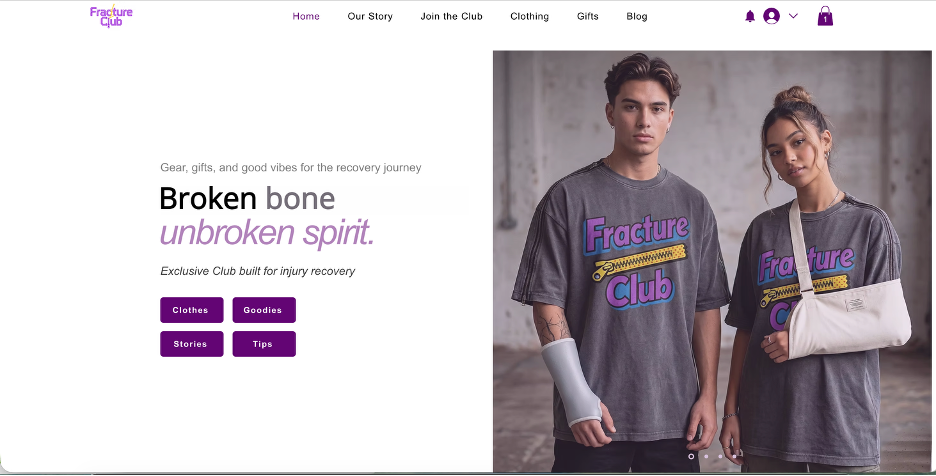
At Fracture Club we make adaptive recovery wear with easy-on/off designs, including magnetic and zipped closures for use with casts and braces, as well as positive-themed gifts for people on the mend. Our unisex easy-on/off sweatshirt for upper limb and bone fracture recovery is a good place to start if your arm is the problem.
[
](fracture-club.com)
Browse the full range of recovery wear and gifts, or use our inquiry page if you have a question about fit for your injury.
FAQ
Is sensory-friendly clothing the same as adaptive clothing?
Not exactly. Sensory-friendly clothing focuses on how a garment feels: soft fabric, no scratchy tags, flat seams. Adaptive clothing focuses on how a garment works for a body with limited movement, such as openings for a cast or easy closures. During recovery, the best pieces do both.
What fabrics are best for sensitive skin during recovery?
Soft cotton and stretch knits are a reliable starting point. A 2024 review reports that studies found cotton, satin and denim preferred for softness, while polyester and wool were described as abrasive or uncomfortable. If your skin is irritated under a brace, ask your clinician what to wear underneath.
Are magnetic closures safe for everyone?
Not for everyone. The University of Delaware’s adaptive clothing manual advises people with an implantable device, stent, pacemaker or defibrillator to get physician approval before using magnetic closures. If you have any of these, ask your doctor first. Zippers with pull rings and hook-and-loop strips are other easy options.
How do I find adaptive clothing in petite or tall sizes?
Look for P or T size labels, and compare them with your own sleeve, torso, rise and inseam measurements, since U.S. sizing is not standardized. Measure in the position you wear the garment, and choose length first for tall frames. Our inquiry page is a good place to ask about fit.
Sources
Sensory Considerations for Emerging Textile Applications (MDPI, 2024)
Dressing Tips for Stroke Survivors (American Stroke Association)
Adaptive Apparel Designer’s Guide to Patternwork (Iowa State University)
Filling the fashion void for shoppers with disabilities (Los Angeles Times)
Clothing and Shoe Size Conversion Charts by Country (Disabled World)
Recommended
Comments