
Fracture Recovery Timeline: What to Expect Week by Week


Most broken bones need about 6 to 12 weeks to heal, but your own timeline depends on which bone you broke, how bad the break was, your age and your health. Feeling fully like yourself again usually takes longer than the bone itself. This guide walks you through the stages, typical timelines by bone, what slows healing and when to call your care team. It also covers the everyday question nobody warns you about: how to get dressed with a cast or brace. That part we know well at Fracture Club.
TL;DR
Bones usually take 6 to 12 weeks to heal, but some fractures take months, and remodeling can continue for years.
Healing has three overlapping stages: inflammatory, reparative and remodeling.
Smoking, diabetes, poor nutrition and some medicines can slow healing. Ask your doctor before changing anything.
Feeling better than the X-ray looks is common. Follow your doctor’s clearance before putting full load on the bone.
Easy-on, easy-off clothing with magnetic or zipped closures makes the weeks in a cast or brace far less frustrating.
Table of Contents
The three stages of fracture healing
Healing is not a switch that flips at week six. The Merck Manual describes three overlapping stages: inflammatory, reparative and remodeling. Here is what each one means for you.
Stage 1: Inflammatory (hours to days)
Right after the break, a blood clot called a hematoma forms around the fracture, according to Mass General Brigham. This is when you have the most swelling and pain. Your job is simple: get the injury looked at, follow instructions on rest and elevation, and let your body start the repair.
Stage 2: Reparative (days to weeks)
Within about 48 hours, cells begin building a soft callus of cartilage and bone around the break. Over the following weeks it hardens. Ask A Biologist from Arizona State University puts the soft callus stage at 4 days to 3 weeks, with the hard callus beginning around 2 weeks after the break and finishing between the 6th and 12th week. New bone can often be seen on X-rays within 7 to 10 days.

The Merck Manual notes that immobilization, such as a cast, is needed during the first two stages so new blood vessels can grow. This is the stage when you live in a cast, splint or brace.
Stage 3: Remodeling (months to years)
The hard callus gradually turns into new, organized bone. This phase can last several years, though you will not feel it. You may be back to normal life long before it finishes. The surgeon Gleeson Rebello of Mass General Brigham says that when a cast comes off, the fracture line may not have fully disappeared, which is why gradual, controlled movement matters.
How long does a broken bone take to heal?
There is no single number. Orthopedic sources give ranges:
The AAOS notes that finger fractures can take 3 to 4 weeks, others 6 to 8 weeks, and some 3 to 6 months or longer.
The Orthopaedic Trauma Association says most fractures need 8 to 12 weeks to heal enough to walk on. Some wrist and foot bones and the tibia (shin bone) heal more slowly.
Splints often come first. The Cleveland Clinic says splinting typically lasts three to five weeks and casts six to eight weeks .
Here are average healing times from South Shore Orthopedics:
Bone | Average healing time |
Fingers and toes | 3 to 6 weeks |
Wrist | 6 to 8 weeks |
Collarbone (clavicle) | 6 to 8 weeks |
Ankle | 6 to 10 weeks |
Arm | 6 to 10 weeks |
Ribs | 6 to 12 weeks |
Spine | 6 to 12 weeks |
Pelvis | 8 to 12 weeks |
Hip | 10 to 12 weeks |
Leg | 10 to 16 weeks |
Treat these as averages, not promises. Dr. Rebello puts it plainly: six weeks and three months are rules of thumb, and every break is different.
Healed is not the same as recovered
The bone can knit before your body feels normal. For an ankle, one orthopedic practice citing the AAOS says bone healing takes 10 to 12 weeks for complete healing, but getting back to normal activity is usually 3 to 4 months. For a wrist, the Merck Manual says it may be strong enough to use after about 2 months, yet forceful gripping can hurt for up to a year, and cold weather can make the area stiffer.
That gap is emotional as much as physical. You are stuck between feeling like a patient and feeling like yourself. Knowing it is normal helps.
A realistic week-by-week picture
Your doctor’s plan always wins over a general guide. With that in mind, here is how many upper-limb and lower-limb recoveries tend to feel.
Week 1: Swelling and pain peak. Expect a follow-up visit soon: most casts and splints are checked within one to two weeks of being applied.
Weeks 2 to 3: Pain usually eases as the soft callus forms. Dressing, showering and sleeping become the daily challenges.
Weeks 4 to 6: The hard callus is forming. Upper-limb bones often reach bone union at 4 to 6 weeks, while lower-limb bones take 8 to 12 weeks, so your cast may come off or change.
Weeks 6 to 12: Many people move to a brace, boot or gentle therapy. Stiffness and weakness are the main complaints.
Months 3 to 6 and beyond: Strength, range of motion and confidence return. Remodeling continues quietly in the background.
Times differ by bone, so ask your doctor which of these checkpoints applies to you.
What can slow healing, and what supports it
You cannot rush a bone, but you can avoid getting in its way.
Smoking and nicotine. The OTA says smoking and diabetes can affect bone healing, and that slow healing does not mean your care was wrong.
Nutrition. The AAOS says healing needs stability, blood supply and good nutrition. A balanced diet with protein, calcium, vitamin C and vitamin D is best. Our guide on post-fracture nutrition goes deeper.
Medicines. MedlinePlus says anti-inflammatory drugs such as ibuprofen and naproxen can slow bone healing, so check with your doctor before using them long term.
Age and bone health. Older adults may have lower bone mass or osteoporosis, and poor nutrition, smoking and heavy alcohol use can harm bones.
Staying safely mobile. Banner Health notes that immobility can raise the risk of muscle loss, weakness and blood clots, so move as your care team allows.
Joint stiffness. The MSD Manual says stiffness is more likely when a joint needs long immobilization.
Going back to activity safely
Feeling good is not the same as being cleared. The American Academy of Pediatrics warns that returning before full recovery can make an injury worse, for example a stress fracture becoming a complete fracture. Before you add exercise, Harvard Health suggests sending your doctor a description of the plan and asking whether it is safe, what to avoid and whether medications need adjusting.
Useful questions for your next appointment:
Is the bone healing on schedule, and what does my X-ray show?
When can I put weight on it or use it normally?
Do I need physical therapy?
Which medicines should I avoid?
After a closed reduction, MedlinePlus says your provider may want you to start gentle movement or physical therapy so the limb does not get too weak or stiff.
When to call your care team
Per MedlinePlus, contact your provider if your cast feels too tight or loose, itches, burns, hurts, cracks or softens, or if you notice fever, chills, swelling, redness or a foul smell.
Seek emergency care for numbness or pins and needles, pain that medicine does not relieve, pale, blue, black or white skin around the cast, trouble moving fingers or toes, chest pain, shortness of breath, or a sudden cough that may produce blood.
Getting dressed while you heal
The timeline is measured in weeks, and you will get dressed about 80 times in the first month. Pulling a sleeve over a cast or twisting into pants can hurt and frustrate you.
Clinical guidance points the same way. UW Medicine’s spinal fusion guidance advises loose tops you can put on without twisting your upper body. A Penn Spine & Orthopedic guide recommends front-opening shirts, elastic waistbands, breathable fabrics and adaptive features such as magnetic buttons and adjustable waistbands to reduce strain.
That is the idea behind our recovery wear. Our easy-on, easy-off shirts and pants use magnetic or zipped closures so you can dress around a cast or brace. For more, see our guides on what to wear with casts, slings and braces and the best way to get dressed after a broken bone or surgery.
[

](https://fracture-club.com/product-page/fracture-club-magnetic-shoulder-zip-tee-injury-recovery-wear)
Recovery wear built by someone who has been there
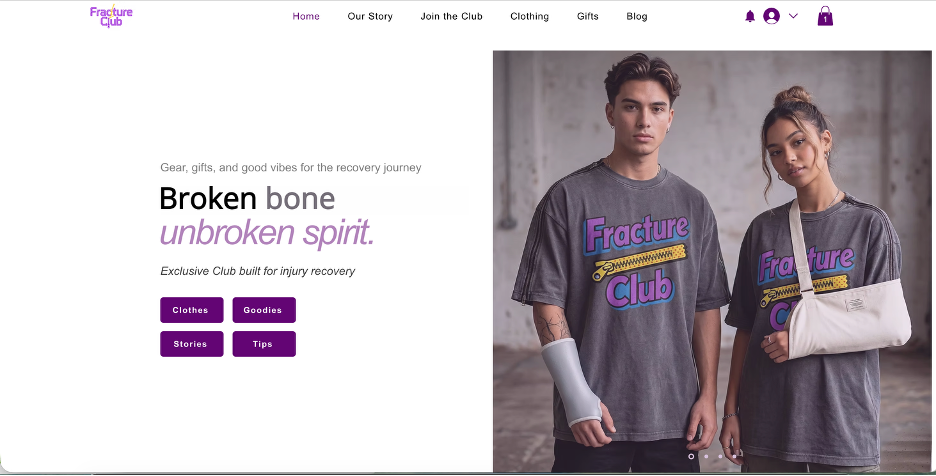
Fracture Club’s recovery wear was designed by someone with lived experience of injury, with magnetic fastenings, zippers and everyday style. Our Unisex Easy-On/Off Adaptive Recovery Pants with Side Magnetic Zippers are one place to start, and you can see the full range of recovery wear and gifts. A portion of proceeds benefits the Bone Health & Osteoporosis Foundation.
[
](fracture-club.com)
Buying for someone else? Our recovery gift ideas and care package checklist can help.
Our perspective
A fracture recovery timeline gives you a number of weeks. It does not tell you how those weeks feel. We built Fracture Club because recovery is also about dignity: being able to put on a shirt without help, and to look like yourself while you heal. We believe comfort is part of recovery. When getting dressed stops being a daily battle, it is easier to rest, follow your doctor’s plan and keep your spirits up. That is why our recovery wear uses magnetic fastenings and zippers, and why we share stories from people who have been through it. Healing is slow, and that is okay. A little encouragement goes a long way, and so does clothing that works with your cast instead of against it. Fracture
FAQ
How long does a fracture take to heal?
Most fractures take about 6 to 12 weeks, though the VA notes that age, health, the type of break and how it is cared for all matter. Some fractures take several months or longer. Your doctor can give you a bone-specific estimate.
What are the stages of fracture healing?
There are three overlapping stages: inflammatory, when a clot forms; reparative, when a soft callus becomes a hard callus; and remodeling, when that callus becomes new bone. The first two usually take days to weeks, and remodeling can take months to years.
Why does my bone still hurt after the cast comes off?
The fracture line may still be visible even when the cast is removed, according to Mass General Brigham, and stiffness is common after immobilization. Gradual, controlled movement helps. If pain is severe or worsening, call your doctor.
Can I speed up fracture healing?
You can support it with good nutrition, not smoking and following your care plan. Ask your doctor before taking anti-inflammatory medicines long term, and about any supplements.
Sources
Recommended
Comments