
Bored With a Cast? Ideas for Your Hands, Mind and Mood


A cast takes away your usual routine, and what it leaves is a lot of hours. The best way through is a mix: something for your mind, something for your hands, something that gets you out of your head, and something that connects you with other people. Add feeling like yourself again, because comfortable clothes you can put on without a struggle change how the whole day feels. Below are ideas for arm casts, leg casts and kids in casts, plus how to check that each one is safe for your healing.
TL;DR
Build your day around four things: a mental project, a one-handed or seated hobby, gentle movement your care team approves, and regular contact with people.
One-handed video games, solo card games, audiobooks and language apps are all easy to start from a couch or bed.
Until your provider says it’s OK, avoid driving, sports and any exercise that could injure the limb. Ask about movement above and below the cast.
Friends and family help most with a simple schedule of visits and a home stocked with low-effort entertainment.
Feeling comfortable in what you wear makes everything else easier, so dress for the cast, not around it.
Table of Contents
Why boredom with a cast hits so hard
You are not being dramatic. A cast keeps the bone still while it heals over weeks to months, and pain usually stops long before the bone is fully healed, according to the American Academy of Orthopaedic Surgeons. That means you can feel well enough to want your normal life back while your body still needs the cast on. For many people that gap feels like being stuck between feeling like a patient and feeling like yourself.
How long it lasts depends on the bone. One guide to broken wrist recovery notes that a wrist typically needs 6 to 8 weeks of immobilization, and the same guide says frustration, boredom and anxiety are normal and that it is worth seeking support if your mood keeps dropping. If that is where you are, tell your doctor. Boredom is a signal worth taking seriously, and it is something you can plan for.
The ideas below are grouped by what they give you, so you can pick from each group rather than binge a single show for six weeks.
Check these things before you start
A few ground rules keep fun from turning into a setback.
Ask your doctor or physical therapist first. U.S. News advises getting their opinion before you start a revised activity routine, since they know your limits and what you can safely do. Increase activity gradually with their guidance.
Know the hard no’s. MedlinePlus says that until your provider says it’s OK, you should not drive, play sports, or do exercises that could injure the limb. If you were given crutches, use them every time you move around. Hopping on one leg risks a fall and a more serious injury.
Skip force, contact and fall risks. One guide lists lifting more than 1 to 2 pounds (as your surgeon directs), pushing, pulling, twisting, putting weight on the hand and submerging the cast as things to avoid unless your surgeon approves otherwise.
Stop if something hurts. The same wrist guide says to stop if pain or fatigue shows up in the affected arm.
Watch for small pieces. Children’s Wisconsin warns that small pieces can slip into a cast. Think twice about tiny game pieces, beads or sand around a child in a cast.
A seated activity is not automatically an easy one. A guide to accessible hobbies points out that a hobby can still involve sustained grip, repetitive hand movements, reaching or lifting supplies. Before you commit, look at your seating position, your lighting, a usable surface, and whether supplies are within reach.
Quiet activities for your mind
These work well in the first days, when you are sore, tired or elevating the limb.
Read and listen
A Kindle or other e-reader is easier to manage one-handed than a physical book, and propping a tablet on a pillow does the same job. Audiobooks and podcasts need no hands at all, which makes them a good fit for resting with your arm raised or leg up. Pick one long series you have been putting off so there is always a next thing waiting.
Learn something
A cast is a natural time for a project with an end point. Language apps such as Duolingo and Memrise, and free courses such as Khan Academy, are common suggestions for people with a broken arm. Coding apps, crosswords and Sudoku are other one-handed cognitive options. Set a small daily target, such as one lesson or one puzzle, and the days start to have shape.
Write it down
Journaling counts, and voice-to-text makes it possible even if your writing hand is the one in the cast. Keeping a running list of things you want to do once the cast comes off is a small, hopeful habit that also gives you something to look forward to.
One-handed games worth trying
Video games
If you play, a casted arm does not mean giving up your hobby. How-To Geek’s list of one-handed video games leans on turn-based and slow-paced titles that do not need fast two-handed controls. It names Slay the Spire and Balatro (turn-based card games), Return to Monkey Island (point-and-click adventure), Civilization VI (strategy), Baba Is You and Tetris Effect (puzzles), and Into the Breach (tactics). Vampire Survivors is free on iPhone, and Into the Breach is free on mobile for Netflix subscribers.
A small caution for teens: one parent-focused guide notes that too many video games can become addicting, so keeping an eye on screen time is reasonable.
Cards and board games
Solo card and board games suit long afternoons. The Strategist’s roundup of one-player games includes Orchard, an 18-card game that can be played in as little as 10 minutes, the deck-builder Friday, and the meditative card game Onirim. It also notes that a standard $6 deck of Bicycle Rider Back cards supports many solo games, including Forty Thieves and Clock. Solitaire needs nothing but a deck and a lap tray.

With company, one-handed play is easy. wikiHow suggests board game nights, with short games like Sorry or Life, longer ones like Catan or Pandemic, or Jackbox party games like Drawful that only need a screen and phones. For kids, one blogger suggests playing Jenga with every player limited to one hand, which evens the playing field.
Hands-on hobbies you can do seated
When you want to make something, keep it simple and stable.
Coloring and paint-by-numbers. Tape the page down so it does not slide.
Sketching. Paper stabilized with tape or a clipboard works, as do coloring books and origami.
Large-piece model building. Choose big parts that do not demand fine grip.
Finger knitting and rainbow loom. Both appear on a pediatric practice’s list of one-armed-friendly indoor activities, and adults can enjoy them too.
Stop-motion movies and rubber stamping. These are good for kids and teens who want a creative project.
Drawing on the cast. It turns the cast itself into the canvas, and our guide to wearing a cast with confidence has ideas for making it feel like yours.
If holding things steady is the challenge, a few everyday supports can help. Items like orthopedic aids for everyday comfort are worth browsing for ways to make seated hobbies and daily routines easier.
Gentle movement your care team may approve
Sitting still all day can leave you stiff and low on energy, and a cast does not have to mean total rest. The AAOS notes that exercises while wearing the cast are important for restoring muscle strength, joint motion and flexibility. Orthopedic surgeon Dr. Bryan Brown of Orlando Health warns that if a cast or splint is worn too long, joints can get stiff and muscles can weaken over four to six weeks, so clinicians balance protecting the injury against those effects.
U.S. News lists options for people in casts, including small handheld weights while seated, leg lifts while lying down, a hand bike with arm pedals on a table, and resistance bands, which are inexpensive and often sold online in packs of five for under $25. A physician quoted there recommends isometric exercises, such as straightening a leg in the air and holding it for 15 to 20 seconds, and stretching above the cast. These are only examples. Which ones suit you depends on your fracture, so run any of them past your doctor or physical therapist first.
If your provider clears you for low-impact activity, UMass Memorial Health suggests seated or standing toss games like cornhole, bocce and shuffleboard for people with limited mobility. For general guidance on starting slowly, Mayo Clinic Health System points to walking, housework and inexpensive home gear like bands and light dumbbells, citing the CDC’s target of 150 minutes of moderate activity per week for US adults. A cast changes what is realistic, so treat that as a long-term aim rather than a cast-week goal.
Stay connected
Isolation is the quiet part of boredom. Plan contact the way you would plan a project.
Host a low-key cast-signing. One pediatric practice describes a simple version: three close friends, a movie, popcorn and markers, described as a relaxed cast-signing party.
Go out when your provider says you can. wikiHow suggests matinee movies, local theater, museums, aquariums and libraries, which are often free or discounted, and dinners or walks with friends.
Go virtual. Question games like Would You Rather, 30 Seconds and trivia can be played over Zoom with friends who live far away.
Share your story. Recovery goes better when other people understand it. Telling friends what a cast is really like, and hearing from others who have been there, makes the days lighter.
Ideas for kids and teens in casts
Children need movement and play more than adults need hobbies, and the guidance from children’s hospitals is reassuring. Lurie Children’s says that for a child in a hip spica cast, books, board or video games, music, TV and visiting friends can lessen boredom, and that family activities and going outdoors may help once caregivers say the child can get out of bed. Nationwide Children’s adds that wiggling toes and fingers and safe games like tossing a ball or Simon Says, along with family time and affection, help keep a child engaged.
For arm casts, Active For Life lists games such as one-armed bean bag toss, scavenger hunts, dance parties and table tennis, and for leg casts, music making, seated volleyball and upper-body chair yoga. The same page quotes a pediatrician who says any activity involving force or contact should be avoided because a mending limb knocked against a person or object can set healing back, while also saying a child in a cast does not need to become a couch potato.
For teens, a mix of friends over, trivia and decorating the cast and crutches works well. Giving them some say in the plan matters as much as the activities themselves.

If you are the friend, parent or caregiver
You do not need a big gesture. A simple support schedule works better: one friend drops off dinner on Mondays, another visits on Thursdays, so the person feels supported without being overwhelmed. The same writer suggests stocking the home with low-effort entertainment, such as adult coloring books, podcasts, yarn, journals, a Kindle or tablet with audiobooks, and meditation apps.
Independence matters too. Small changes, such as moving the coffee maker to a lower shelf or keeping favorite items within reach, can make a large emotional difference during recovery.
If you are looking for a gift, our post with thoughtful gift ideas for loved ones with broken arms is a good place to start.
Make the days feel normal again
Boredom often comes with a second frustration: getting dressed. When pulling a sleeve over a cast takes five minutes and leaves you worn out, it is easy to give up and stay in pajamas all day. That makes the day feel flatter. Getting dressed, even in soft, simple clothes, is one of the easiest ways to feel like yourself.
Our tips for dressing with an arm cast walk through the basics. If nights are the problem, see our guide to pajamas for an arm cast, and for legs, our overview of leg cast clothing solutions.
Our perspective
We built Fracture Club because recovery is not only physical. It is a long stretch of days when you are asked to wait, and waiting is hard when you feel fine from the neck up. What we hear in the recovery stories we share is that the small things matter: being able to get dressed alone, sitting down with a favorite game, being included by friends. Our recovery wear was designed by someone with lived experience of injury, with magnetic fastenings and zippers so that dressing around a cast or brace is easier, and with an everyday style so you do not have to feel like you are wearing a hospital uniform. Part of our mission is a community that lifts spirits, and a portion of our proceeds benefits the Bone Health & Osteoporosis Foundation. If you are bored, frustrated or just tired of waiting, you are not alone, and the days do get lighter. Fracture
Comfortable clothes for the days you are home
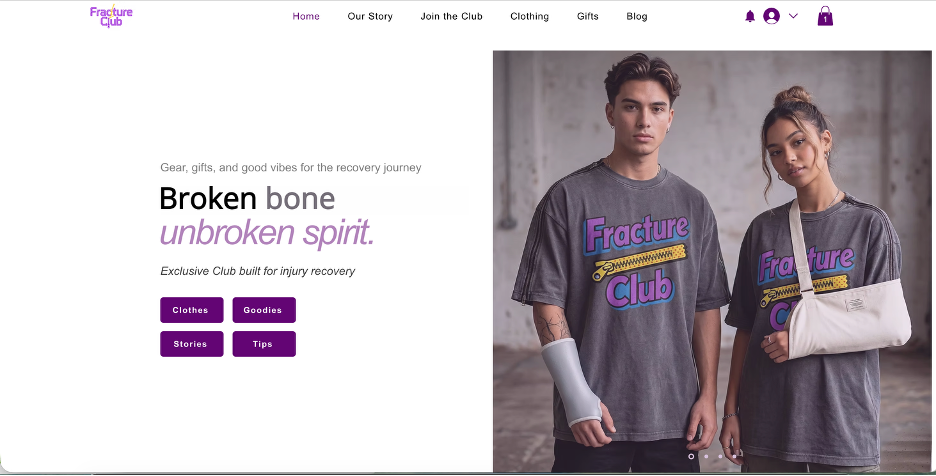
When your days are spent on the couch, at the table or in video calls with friends, what you wear matters more than you might expect. Our recovery wear includes easy-on/off shirts and pants with magnetic or zipped closures, made for use with casts or braces, plus positive-themed recovery gifts for people who are healing.
[
](fracture-club.com)
Browse our Easy-On/Off Sweatshirt for upper limb injury recovery, our Unisex Easy-On/Off Adaptive Recovery Pants, or the full recovery wear and gifts collection.
A simple weekly plan
If choosing is the hard part, here is one way to structure a day. Adjust it to your energy and your doctor’s advice.
Time of day | What to try |
Morning | Get dressed, then a language lesson, puzzle or journal entry |
Midday | Audiobook or podcast while resting with the limb elevated |
Afternoon | A one-handed game, a creative project or an approved gentle exercise |
Evening | A call, a visit, a movie with someone, or a board game |
Add one small goal each week, such as finishing a book, reaching a new level in a language app or planning a first outing once your provider says it is OK. Cast days feel long when they all look the same, and little milestones break them up.
FAQ
What can I do when I’m bored with a cast?
Mix quiet mental activities (audiobooks, language apps, puzzles), one-handed games, seated creative projects and time with other people. Add gentle movement only after your doctor or physical therapist approves it. Having something planned for each part of the day helps the most.
What games can I play with a broken arm?
Turn-based video games, solo card games like solitaire and one-handed board games all work. Slay the Spire, Civilization VI and Baba Is You are among the video games recommended for one-handed play, and a standard deck of cards covers many solo games. With friends, try trivia, Jackbox games or Jenga played one-handed.
Can I exercise while I have a cast?
Often some movement is helpful, but it depends on your injury. MedlinePlus says to avoid exercises that could injure the limb until your provider says it’s OK, so ask your doctor or physical therapist which movements above and below the cast are safe for you.
What can I do for a child who is stuck in a cast?
Children’s hospitals suggest books, board games, music, visits from friends and safe active games like Simon Says. Avoid small pieces that could slip into the cast, and skip anything involving force or contact. Follow your child’s care team on when outings and more active play are fine.
Sources
Closed reduction of a fractured bone, aftercare (MedlinePlus)
You Can Play These Video Games With Only One Hand (How-To Geek)
22 Fun Activities for Teenagers With a Broken Leg (Mindfulness Mama)
18 Best One-Player Board Games and Card Games (The Strategist)
One Handed Activities for a Child with a Broken Arm (Mama’s Miles)
How Someone with Limited Mobility Can Stay Active (UMass Memorial Health)
Need to get moving? Start slowly (Mayo Clinic Health System)
23 Activities For Teenagers With A Broken Leg Or Arm (Hugateen)
Recommended
Comments