
Magnetic Buttons for Shirts: How They Work and How to Choose


Magnetic buttons for shirts are fasteners that hold a shirt closed with small magnets instead of thread-and-hole buttons. A button-looking cap on the outside keeps the shirt looking normal, while the magnets hidden underneath do the work. You can buy shirts with them built in, or add magnetic hardware to shirts you already own. If a cast, a brace, a sling or sore hands make buttons a daily fight, they can turn a five-minute struggle into a few seconds.
This guide explains how the closures work, which type fits which situation, what to check for safety, and how to wash them. We wrote it for people healing from an injury and for the friends and caregivers who help them get dressed.
TL;DR
Magnetic shirt closures pull together when the two sides get close, so you don’t need to line up a button and a hole or pinch anything small.
There are two routes: shirts made with magnetic closures, or add-on magnetic hardware and button adapters for shirts you already own.
If you have a pacemaker or another implanted device, talk to your doctor before wearing magnetic clothing, and keep magnets well away from the device until you do.
Wash with care: magnets can cling to a metal washer drum or dryer, so close the closures and check what the maker recommends.
For recovery, the goal is independence and comfort. Magnets help you dress. They do not treat pain or speed healing.
Table of Contents
What magnetic buttons on shirts actually are
A magnetic closure is a pair of small magnets, each sealed inside a housing, sewn or attached on opposite sides of an opening. Bring the two sides near each other and they snap together. One patent for adaptive clothing describes magnetic members in housings that fasten garment layers when brought into proximity, and notes that a button on the exterior can give the garment the appearance of a buttoned placket.
That last detail is why the category has grown. The shirt looks like any other button-down. The buttons are decorative, and the magnets are doing the holding.
You will see the idea sold under several names, such as magnetic closures, magnetic shirt closures, magnetic fasteners and magnetic snaps. They are all variations on the same principle. What differs is how the magnets are mounted and how much of the work happens out of sight.
Why they help when you’re injured
A regular shirt asks a lot of your hands: pinching a small disc, aiming it at a slit, pushing it through, repeating that six or seven times, often with the wrong hand. With one arm in a cast, a wrist brace or a sling, that is a real barrier. It is also the kind of small daily defeat that makes you feel stuck between feeling like a patient and feeling like yourself.
Magnetic closures remove most of the precision. Clinicians who work on dressing difficulties point in the same direction: the Parkinson’s Foundation notes that tremor can make dressing hard and that magnetic closures can simplify getting dressed. A tremor isn’t a fracture, but the problem is similar. Your fingers can’t do fine work, so the clothing should ask for less.
In practice, here is where they help most in recovery:
One-handed dressing. You can close a placket by laying the two sides together and sliding your hand down, instead of fastening each button.
Over a cast or brace. A closure that opens fully lets you get a bulky arm through a sleeve without forcing it over a cast. Our guide on when magnetic closures beat zippers for one-handed dressing covers where each one works best.
Sore shoulders and limited reach. Fewer tiny steps means fewer awkward twists.
Fatigue and pain days. Some mornings you have energy for exactly one hard thing. Getting dressed shouldn’t use it up.
Helping someone else. A caregiver can close a shirt in seconds without fiddling at someone’s chest or wrist. We go deeper on this in 4 ways adaptive clothing beats regular clothes for caregivers.
One honest limit: magnets make dressing easier. They are not a pain treatment, and we say so plainly in our piece on magnetic clothing benefits.
Three ways to get magnetic closures on a shirt
Most shoppers searching for this are really choosing between three routes. Here is how they compare.
Option | What it is | Best for | Trade-offs |
Shirts made with magnetic closures | The magnets are built into the placket during manufacturing | Daily wear, the cleanest look, the least hassle | You buy a new garment |
Magnetic button adapters | No-sew pieces that convert an existing shirt’s buttons into magnetic closures | Keeping a favorite shirt, short-term recovery | Fit depends on your buttons and fabric |
Sew-on magnetic snaps or buttons | Magnetic hardware you stitch in yourself | Alterations, DIY, jackets and cuffs | Needs sewing skill or a tailor, and the sewing itself is hard with one hand |
Built-in magnetic closures
This is the simplest answer. The closures are positioned and reinforced by the maker, so you don’t have to guess placement. Quality here comes down to whether the magnets are sealed, how well the placket lies flat, and whether the shirt still looks like clothing you would choose.
A university adaptive clothing manual lists adaptive shirts with magnetic closures among the options, alongside magnetic sew-on snaps for altering garments you already own.
Button adapters for shirts you already own
If you love a shirt and only need it for a few weeks, adapters are tempting. One patent on a magnetic button adapter system describes no-sew adapters that convert existing shirt buttons into magnetic closures and can be machine washed and dried once attached. Real products vary, so check the maker’s care instructions before you rely on that.
A practical tip: have a friend or family member attach them for you. Placement matters, and it is much easier with two working hands and the shirt laid flat.
Sew-on magnetic snaps
These suit people who already sew, or who have a tailor. The same university manual notes that plastic coverings protect magnetic snaps against rust, which is worth looking for. If you are choosing hardware, pick pieces that are fully encased rather than bare metal discs.
What to look for before you buy
Not every magnetic closure performs the same. These are the checks that matter.
Closure strength that fits you
Too weak, and the shirt gaps open when you reach. Too strong, and you can’t pull it apart with a weak hand. A resource guide from Vanderbilt describes the design goal as strength that keeps the shirt closed while still letting the wearer separate the fasteners easily. When you try a shirt, test it the way you really move: reach overhead, lean forward, lift something light. Then open it with your non-dominant hand.
Comfort against skin
Hard points under a collar or along a placket get irritating when you’re sitting or lying down much of the day. Look for closures that sit flat and are covered by fabric. Soft-tissue areas and healing skin need extra care, so avoid anything with rough edges near a surgical site or incision, and ask your care team about clothing over healing skin.
A normal look
Many people recovering from injury don’t want to look like they’re wearing a medical garment. That is a fair preference, and it affects whether you actually wear the clothes. Shirts with decorative buttons over hidden magnets keep the familiar silhouette. If you want to see what conventional styling looks like in a collared shirt, browsing a plain selection of men’s button-down shirts is a good way to decide which collar, pattern and fit you want before you look for a magnetic version.
How much opening you need
A placket closure helps with buttons. But if your cast or brace is the main obstacle, you may need a shirt that opens wider, such as a shoulder or sleeve opening, so you can get the arm in without lifting it. That is why we designed our Magnetic Shoulder Zip Tee around easy access rather than around a standard front placket.
[

](https://fracture-club.com/product-page/fracture-club-magnetic-shoulder-zip-tee-injury-recovery-wear)
Safety: pacemakers, implants and MRI
This is the part not to skip. Small magnets in clothing are generally weak compared with the strong magnets in some electronics, but if you have an implanted medical device, you should not guess.
The U.S. FDA says that certain consumer electronic devices with high field strength magnets may affect some implanted medical devices. It recommends keeping consumer electronics that may create interference at least six inches away from the implant, and contacting a health care provider if you have symptoms or questions. The FDA page is about phones and watches, not shirts, but the principle carries over: if you have a device, ask before you add magnets near it.
A few practical steps:
Ask your care team first. An occupational therapist, your physician or the clinic that manages your device can tell you whether magnetic clothing is appropriate for you. A university occupational therapy resource gives the same advice, especially for anyone with a pacemaker or other metal device.
Keep the closures away from the device site until you have an answer. Placing them on a cuff or lower placket puts distance between the magnets and your chest.
Tell caregivers. Whoever helps you dress should know about the device and your doctor’s guidance.
Mention magnetic clothing before any scan. Procedures such as MRI involve very strong magnetic fields. Remove or check any clothing with magnets, and let the imaging team know what you’re wearing. Ask the imaging center about its rules.
We’ve written more on this in magnetic closures and pacemaker safety for recovery patients and caregivers and in our look at magnetic closure safety for recovery wear users.
Washing and care
Magnets are small, but laundry is rough on them. The adaptive clothing manual we mentioned earlier says plastic coverings protect magnetic snaps against rust, but it also warns that magnets may stick to metal washers and dryers. A patent describing waterproof plastic housings says they help prevent damage across repeated washes, and that is what you want from a well-made closure.
Simple habits keep them working:
Close the closures before washing. Paired magnets stay put and don’t grab the drum.
Use a mesh bag or turn the shirt inside out for extra protection.
Follow the care label. Heat and aggressive cycles are the usual culprits for any garment hardware.
Check the housing after a few washes. If a casing is cracked or a magnet is exposed, stop wearing it. Exposed magnets can rust and may come loose.
Keep magnets away from children and pets. Loose magnets are a swallowing hazard. If a magnet comes off, pick it up right away.
A quick buying checklist
Before you add anything to your cart, run through these questions:
Is the magnet sealed in plastic or fabric, not exposed?
Can I open it with my weaker hand?
Does it stay closed when I reach, bend or sit?
Will it sit flat under a sling strap, seat belt or brace?
Does the shirt open wide enough for my cast or brace?
Have I asked my doctor or OT about magnets if I have an implant?
Do I like how it looks? If I don’t, I won’t wear it.
Our perspective
We started Fracture Club because getting dressed during an injury is not a small thing. Our recovery wear was designed by someone who has been through it, and that shapes every choice. We don’t treat magnets as a gimmick. We treat them as one tool, alongside zippers and wider openings, for a simple goal: letting you dress yourself, in clothes you’re happy to be seen in.

Here is what we have learned. First, the best closure depends on the injury. Magnets are great for placket fastenings and cuffs, but a long side zipper may do more for pants over a cast, and sometimes you want both. Second, looking like yourself matters as much as function, because people wear the clothes that make them feel like themselves. Third, safety questions deserve a real answer from your doctor, not from a shopping page. We would rather you ask and wait than assume.
And recovery is easier with company. That’s why we share stories from our community and donate a portion of proceeds to the Bone Health & Osteoporosis Foundation.
— Fracture
Where Fracture Club fits
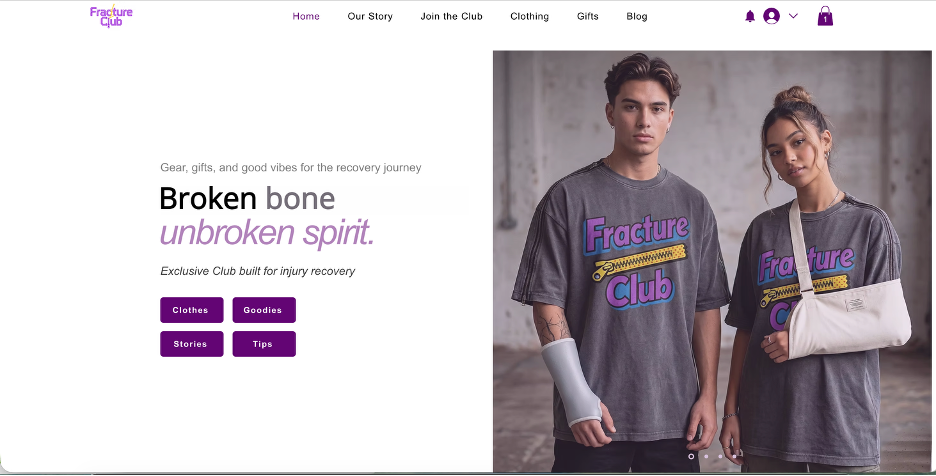
If you’re looking for clothing designed around casts and braces, our recovery wear uses magnetic and zipped closures so you can dress with less struggle, without giving up everyday style. For lower-body needs, our adaptive recovery pants with side magnetic zippers are made for getting on and off over a cast or brace, and the unisex magnetic zipper pants suit post-surgery and warm-up wear. Not sure what to pick? Read about the benefits of adaptive recovery pants.
[
](fracture-club.com)
Browse the full range of recovery wear and gifts, or send us a question through our inquiry page if you want help matching a piece to your injury. Buying for someone else? Our merch and gifts are made to celebrate resilience and make a hard stretch feel a little lighter.
Tips for the first week with magnetic clothing
A new closure takes a day or two to feel natural. A few things help.
Practice sitting down. Try your first shirt when you’re not rushed, ideally seated, so you learn how the two sides meet.
Line up the placket from the bottom. Start at the lowest closure and slide upward. Alignment is easier that way.
Dress the injured arm first. Whichever side is in a cast or brace goes in first, then bring the shirt around.
Keep a backup. Have one or two shirts you can rely on during rough days, with the same closure type, so your routine stays predictable.
Let someone help the first few times. Not because you can’t, but because a second pair of eyes helps you learn where the closures sit.
FAQ
Are magnetic buttons on shirts strong enough to stay closed?
Well-made ones are. Strength varies by design, so test how a shirt holds when you reach and lean. The aim is a closure that stays shut during normal movement yet opens with a gentle pull from a weak hand.
Can I add magnetic buttons to a shirt I already own?
Yes. You can use no-sew adapters that convert existing buttons, or sew-on magnetic snaps. Adapters are easier if someone else can attach them, and you should check the maker’s wash guidance first.
Are magnetic shirts safe with a pacemaker?
Ask your doctor or the clinic that manages your device before wearing them. The FDA advises keeping consumer electronics that may cause interference at least six inches from implanted devices and contacting a health care provider with questions. Until you have an answer, keep magnetic closures away from your chest.
Can I wear magnetic clothing for an MRI?
Tell the imaging team about it before the scan. MRI uses very strong magnetic fields, and facilities generally ask you to remove metal items, so expect to change into a gown or ask them what is acceptable.
Can magnetic shirts go in the washer and dryer?
Most can, if the magnets are sealed and you follow the care label. Close the closures first, since magnets may cling to metal drums, and check the casings now and then for cracks.
Sources
Recommended
Comments